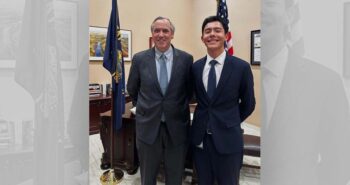
Two years ago, during an impactful summer in Washington, D.C., I participated in the Tibetan Youth Leadership Program. Here, my cultural identity, passion for providing aid, prior work experiences, and academic interests converged as a unified pathway toward meaningful impact. That summer, I was made aware of ICT’s Washington Internship Program for Tibetan-Americans and was encouraged to apply. After such a formative experience, I realized that my passion for supporting diaspora communities could be built on by such an opportunity.
Zhang Yadi: The 22-year-old student Beijing fears

数月前对话,如今失联被捕:22岁“挺藏“思想犯张雅笛的故事|往事要再提06
Tara Freesoul on X/Twitter
December 18, 2025 By: Vincent Metten
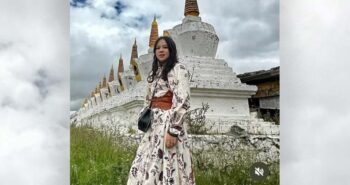
Zhang Yadi is 22 years old. Friends describe her as bright, curious, and determined to understand the world beyond the censorship and information controls imposed by the Chinese authorities on its citizens. During her studies in Paris, she developed a strong interest in questions of freedom of expression, equality between peoples, and human rights, especially concerning Tibet.
As the observed July 6 birthday of H.H. the Dalai Lama nears, his well-wishers throughout the world have already begun their own respective ways to organize events or launch initiatives to recall his impact on the community. I wanted to dwell on three such initiatives today. June 6, 2025 saw the special screening of the iconic 1997 film “Kundun” at the Tribeca Film Festival in New York City, in partnership with the International Campaign for Tibet (ICT).
The first week of May 2025 saw an important spiritual process, namely the selection of the new Pope. Leo XIV, by the eligible members of the College of Cardinals. Despite the political interest many countries have in the papacy, the spiritual process was followed according to the Roman Catholic tradition, without governmental interference, particularly from the Italian Government even though he also holds the title of Bishop of Rome.
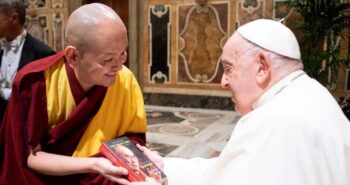
“On March 31, 1959, my party entered India. I have not been able to go back to my homeland since,” His Holiness the Dalai Lama writes somewhat poignantly about his dramatic escape from Tibet in his latest book, Voice for the Voiceless: Over Seven Decades of Struggle with China for My Land and My People (Harper Collins, 2025). Being published in the 66th anniversary of his escape and on his 90th birthday year. Through this book, His Holiness succinctly outlines his master plan for Tibet. Allow me to expand.
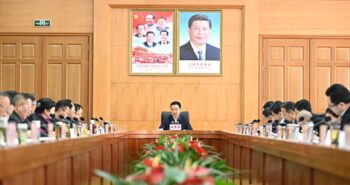
An important anniversary for the rule of the Chinese Communist Party in Tibet is looming. September 1st marks the 60th anniversary of the dismemberment of Tibet under the Chinese occupying forces. This was recently pointed out by Communist Party Secretary Wang Junzheng, the highest-ranking Chinese official in Tibet's capital, according to Chinese propaganda media reports.
I was born in Dharamsala, India, a place that serves as the heart of the Tibetan exile community. Growing up in a home where every conversation was laced with stories of our resistance, resilience, and hope, I understood from an early age what it meant to be Tibetan in exile. When I moved to New York City, that understanding took on a new dimension. The 23-hour journey from India to the U.S. marked not just a geographic shift but a transition in my identity. In America, I had to learn how to balance the weight of my Tibetan heritage with the reality of growing up in a country that often...
Every four years, the United States experiences an upheaval of sort, depending on the outcome of the presidential elections. Like earthquakes, sometimes changes are minor while sometimes they are major ones, including with subsequent tremors. This year we are going through another such upheaval with President Donald Trump having won and bringing in a new set of officials.
I was born and raised in New York City by Tibetan refugees. My parents were born in Tibet, escaped to India in 1959, and ultimately immigrated to New York in the early 1990s. It’s a point of pride for me to share that I am a Tibetan, an American, and a New Yorker. Growing up, the Tibetan community in New York was small. In the early 2000s, our Sunday Tibetan school was made up of a couple dozen students when my brothers and I first joined, and our apartment often served as a temporary home for newly arrived Tibetan friends navigating their first steps in this city.
A blessing in disguise of a tragedy, if I can even dare say, is that it brings out the positive side of people all over. That was the experience of the Tibetan refugees in the immediate period following their escape from Tibet in and after 1959, when there was an outpouring of material and moral support from the international community.
Yudru Tsomu’s meticulously researched new book, Chieftains, Lamas, and Warriors: A History of Kham, 1904-1961, provides a welcome addition to narratives on Tibetan history by framing Tibet’s eastern province not as a remote periphery but instead as a crucial zone of contestation between Central Tibet and China.