By: Tenzin Yiga
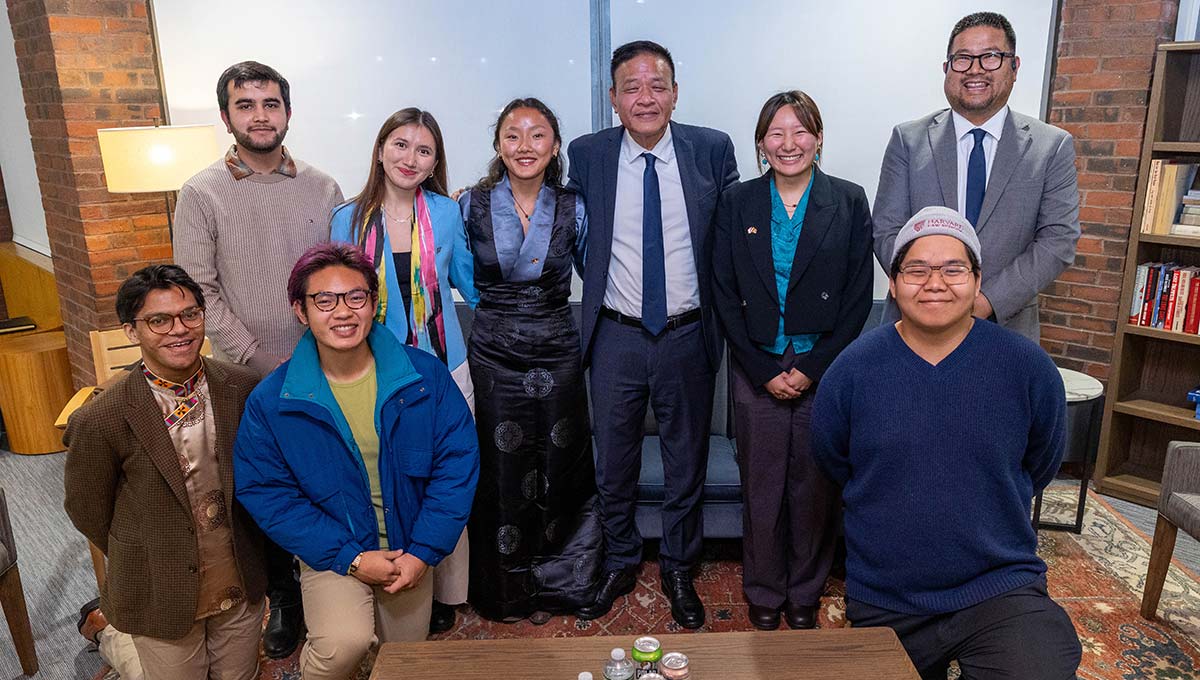
Sikyong Penpa Tsering poses with students after a forum hosted at Harvard University.
Standing on the stage of the John F. Kennedy Jr. Forum at Harvard’s Institute of Politics, I could feel the weight of nearly 30 years of silence in the room. It was November 28, 2025 and for the first time since His Holiness the 14th Dalai Lama spoke at the Kennedy School of Government in 1995, a Tibetan leader was returning to that stage to continue an unfinished conversation. I was one of the only Tibetan students at Harvard, and introducing Sikyong Penpa Tsering—the democratically elected President of the Central Tibetan Administration—was more than a personal honor. It felt like a turning point, not just for Harvard, but for how American college campuses engage with the issue of Tibet.
For decades, Tibet has been a footnote in American discourse on China, often overshadowed by conversations about international trade, technology, and geopolitical competition. In the 1980s and 1990s, many college campuses centered Tibet as a critical human rights issue among student activist groups. Since then, a once roaring and passionate cause has faded into the background. But something is shifting. The JFK Jr. Forum on “Tibetan Democracy in Exile” was an unambiguous statement that Tibet belongs in the most rigorous spaces of academic and policy discussion. And if a mere undergraduate student like me could organize and ideate such a large-scale and significant event like this at Harvard, change must also surely be coming to other campuses across the country.
Coming at such a critical juncture in geopolitics, this Forum could not have been more urgent. In 2024, the US Congress passed the Promoting a Resolution to the Tibet-China Dispute Act, signaling renewed American commitment to Tibetan self-determination. Meanwhile, China’s assimilation policies in Tibet have intensified—eroding language, religion, and cultural identity through state-run residential boarding schools, forced labor programs, and surveillance systems. The Tibetan Plateau, often called the “Third Pole,” is experiencing rapid glacial melt, threatening water security for billions of people across Asia and around the world. Tibet is not a relic of Cold War-era activism; it is a living, evolving crisis that intersects with human rights, climate change, geopolitics, national security, and the future of democracy itself.
Yet even with tens of thousands of Tibetan-Americans living in the United States, Tibet has largely disappeared from the conversation on college campuses. Student groups that once rallied for Tibetan freedom have dwindled or disbanded. Courses on Asian history and politics often reduce Tibet to a brief historical mention, and many colleges don’t offer comprehensive courses or departmental spaces for Tibetan studies. The vibrancy that once characterized campus activism around Tibet has dimmed, replaced by a sense that the issue is too complex, too intractable, or simply too distant to matter.
The Forum challenged that narrative. Sikyong Penpa Tsering’s presence at Harvard reminded us that Tibet is not a lost cause—it is a living and thriving democratic project. The Central Tibetan Administration has held free and fair elections across a scattered global diaspora for over six decades, maintaining civic participation, transparent governance, and peaceful transitions of power without a single inch of sovereign territory. For students studying democracy, international relations, or statelessness, the Tibetan model offers one of the most compelling case studies in modern governance. It addresses questions like: How does a community sustain democracy when it has no state? How do you establish and maintain legitimacy when your government is in exile? These are not abstract ideas—they are urgent lessons for a world grappling with authoritarianism, mass displacement, and the erosion of democratic principles. Tibet offers students a powerful lens through which we can examine democracy, human rights, environmental security, and the future of US-China relations.
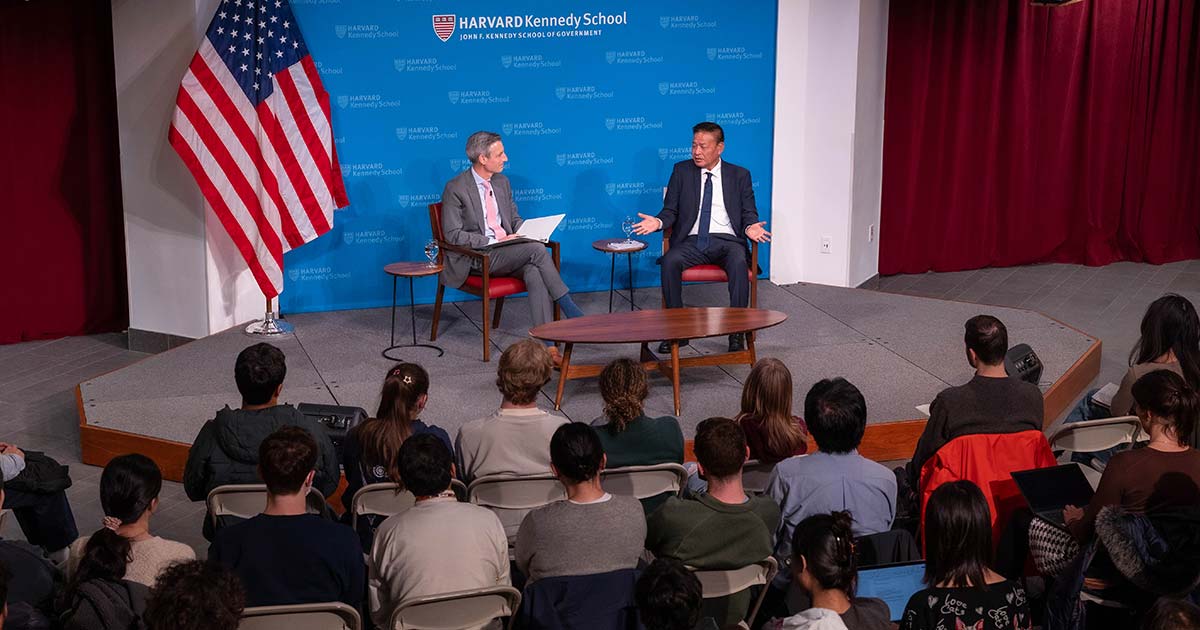
Sikyong Penpa Tsering speaks at the John F. Kennedy Jr. Forum at Harvard’s Institute of Politics in November 2025.
For me, this Forum was deeply personal. I was born and grew up in India, at the heart of the exile Tibetan community, and later moved to New York City. Across these different geographies, I was always aware of the Tibetan struggle. However, it wasn’t until I arrived at college that I truly understood how isolated that struggle had become in American academic spaces. Walking through campus, attending lectures, and engaging with peers, I realized that many students knew virtually nothing about Tibet beyond surface-level Hollywood treatments or vague associations with His Holiness the Dalai Lama or spirituality. Even at Harvard, surrounded by brilliant and politically engaged minds, my classmates and friends seemed shocked to find out about what was happening in Tibet. The brutal invasion, the ongoing repressive occupation, present political reality, as well as the democratic resilience of the exile community—it was all absent from their awareness.
I scoured past Forums for any mention of Tibet, and found none. I realized then that it was up to me to take the initiative, to enact that change, and that no one else would be there to hand me the opportunity. That is when I decided to draft up a Forum proposal and reach out to Dr. Namgyal—USA Representative of His Holiness the Dalai Lama—at the Office of Tibet in Washington, DC. This wasn’t just about hosting a speaker or for my own accolades, it was about uplifting my community and reclaiming space for Tibet in one of the most prestigious academic institutions in the world. The JFK Jr. Forum has a legacy of hosting leaders who shape global political discourse including presidents, ambassadors, activists, diplomats, and visionaries. His Holiness the Dalai Lama spoke there in 1995, at a time when Tibet was still a prominent issue in US foreign policy.
After various obstacles, the Forum was approved and the date was set. Standing on that stage to introduce the Sikyong, I felt the responsibility of breaking a 30-year silence. I wasn’t just speaking as a student or as a moderator—I was speaking as a Tibetan-American who grew up believing that our voices mattered, that our struggle was worth fighting for, and that the world would eventually listen. The Forum was proof that those beliefs were not naive.
The success of the JFK Jr. Forum on Tibet should serve as a blueprint for campuses nationwide. If Harvard—a university with deep ties to China, significant Chinese student enrollment, and complex institutional considerations—can host a robust, unapologetic conversation about Tibetan democracy, then so can every other university in America. This Forum demonstrated that engaging with Tibet is not about antagonizing China; it is about upholding the values that America and its universities claim to champion — free inquiry, human rights, and the rigorous pursuit of truth. We proved that students are hungry for these conversations, faculty are eager to engage, and the broader public is ready to listen. To every student reading this: if you care about democracy, if you care about human rights, if you care about holding authoritarian regimes accountable, then you should care about Tibet. And if your campus is not talking about it, then it is up to you to make them. Organize events, invite speakers, start conversations.
But this Forum cannot be a one-time event. The revitalization of Tibet on college campuses requires sustained effort, institutional support, and student-led initiative and advocacy. Whether it is more academic integration, student activism and organizing, engagement with Tibetan leaders, research and policy work, or coalition building, American universities have a responsibility to engage with this issue, not as a favor to the Tibetan community but as a matter of intellectual honesty and moral clarity.
For me, the JFK Jr. Forum was a reminder that the fight for Tibet is not over. In fact, as long as Tibetans are living under fear and intimidation every single day in their homeland, those of us living in the free world bear the responsibility to continue to advocate for their voices to be heard. And we must do it together—on every campus, in every classroom, and in every conversation about the future of democracy and human rights. The stage is set and now it’s up to all of us to keep the conversation going.