Gyaltsen Norbu
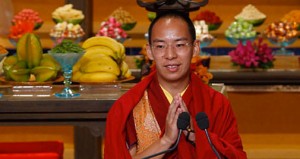
Gyaltsen (Gyalcain) Norbu, 25, was installed by the Chinese authorities as part of their efforts to ensure control of Tibet and assert their authority over a future incarnation of the Dalai Lama,[2] and is compelled to conform to the role of ‘official’ Panchen Lama as a ‘patriotic’ figurehead with allegiance to the CCP. This perhaps makes one of his statements in the March 2 speech, before top Chinese leaders at a Party meeting,[3] all the more telling. Because of the shortage of monks in Tibet and “quotas set too low”, he says, there is “a danger of Buddhism existing in name only”.
Gyaltsen Norbu made the usual provisos in line with Party policy, asserting that Tibetan Buddhism is thriving in Tibet, just as the 10th Panchen Lama carefully framed his arguments.[4] But his main contention counters existing policy – for instance, officials do not even admit to monastic ‘quotas’.
The context of the March 2 speech, which has appeared so far only in Chinese in the state media, is an intense debate on the future of Buddhism in Tibet and China. More Chinese people are becoming devout followers of Tibetan lamas,[5] and Xi Jinping talks about the importance of China’s ‘traditional cultures or faiths’ including Buddhism. The Chinese Communist Party wants to give an impression that Buddhist faith is flourishing in Tibet and is acutely aware that the leaders of its main schools all reside in exile, with the Dalai Lama a globally respected figure. So they may be seeking to use Gyaltsen (Chinese: Gyalcain) Norbu in a more sophisticated way than before, and his comments may reflect an approach that some officials want to convey. Even so, Gyaltsen Norbu’s speech was reminiscent of the skillful phrasing used by the 10th Panchen Lama in parts, and he has made lengthy visits to a number of Tibetan monasteries, with senior lamas and scholars as his teachers. Their concerns appear to be reflected in his comments.
Gyaltsen Norbu’s speech is framed carefully in accordance with the Party line on religion, stating that in the “glow of the Party’s ethnic and religious policies”, Tibetans, Uyghurs and other ethnicities enjoy “freedom of religious belief” and normal religious practice and preservation of culture. But his main contention differs from policies that threaten the survival of Tibetan Buddhism in Tibet today, as he pinpoints the shortage of monks in Tibet and “quotas set too low” as serious problems.
The Chinese authorities do not openly admit that ‘quotas’ on monks and nuns in monasteries and nunneries exist. The government line is that the correct number of monks varies according to the monastery’s capacity to support them; Buddhist associations and monastic management committees are the proxies for the government in approving or reviewing such matters. In effect, this represents a government-approved ‘quota’.[6]
On February 12, Gyaltsen Norbu was pictured by the state media with Sun Chunlun, the head of the United Front Work Department who is also on the top Politburo.[7] It is unlikely that Gyaltsen Norbu would make the March 4 speech before members of China’s top leadership[8] without any official approval beforehand, although this may not have been from the United Front Work Department, which seeks to uphold a strong line on religious policies in Tibet and hostile approach towards the Dalai Lama. By directly addressing his remarks to Yu Zhengsheng, one of China’s top leaders who heads an important Party committee on ethnic and religious affairs, Gyaltsen Norbu effectively cut out any attempts by Tibetan or other less senior officials to filter his comments. Such officials, including from the United Front, normally serve as a buffer telling the central government that central religious policies are a success and there is no need for concern.
The context of the Chinese Panchen Lama’s comments is a deteriorating environment for Tibetan Buddhism which worsened significantly after overwhelmingly peaceful protests swept across Tibet in March and April 2008. The Chinese Communist Party state responded to the protests by intensifying an established anti-Dalai Lama campaign, issuing sweeping regulatory measures that intrude upon Tibetan Buddhist monastic affairs and implementing aggressive “legal education” programs that pressure monks and nuns to study and accept expanded government control over their religion, monasteries, and nunneries.
A further factor contributing to the shortage of monks – and one that is not mentioned in Gyaltsen Norbu’s speech, although it is perhaps implied – is the expulsion of monks and nuns from many monasteries, particularly in the Tibet Autonomous Region. Since a wave of overwhelmingly protests spread across Tibet in March, 2008, monasteries of historic and cultural significance have been targeted by the authorities. After monks from the ‘Great Three’ monasteries in Lhasa of Sera, Drepung and Ganden took to the streets in March, 2008, the monastic population has been subject to intensified suppression and the strengthening of control mechanisms.[9] Hundreds of monks have been expelled and arrested from these three monasteries, leading to serious fears for their survival as religious institutions.[10]
Gyaltsen Norbu’s comments appear to reflect a genuine alarm that monasteries in the Tibet Autonomous Region that once housed thousands of monks are now reduced to a few hundred whose main responsibility is no longer religious study but tending to the buildings and tourists. Many of the monks in these major monasteries were from Amdo, Kham, Mongolia, and the broader Himalayan region, and Gyaltsen Norbu does not mention in his speech the policies restricting them from studying in the Tibet Autonomous Region. The number of monks studying at large religious encampments in Tibetan areas of Kham, such as Larung Gar (Serthar) serves as a visible reminder of the potential that monasteries in the Tibet Autonomous Region are not allowed to fulfill.
After the 2008 protests, Tibetan language, culture and monasteries have been depicted by many Party officials as a source of instability. In his speech, Gyaltsen Norbu re-frames the issue by depicting them instead as a source of “stability”, saying: “Tibetan Buddhism is capable of playing a huge role in national economic and social development, and social harmony and stability.” In this way he opens a discussion of Buddhism and Buddhist ceremonies and rituals as something that people in the Tibet Autonomous Region require, and the lack of ability to provide these services as a shortcoming.
Gyaltsen Norbu gives a higher number of monks and nuns in Tibetan areas than usually acknowledged in official statistics, indicating that even this higher figure is not enough. He refers to 1,787 religious venues with 46,000 resident monks and nuns in the Tibet Autonomous Region, plus 783 monasteries and 68,000 monks and nuns in Sichuan, and 660 monasteries and 44,500 monks and nuns in Qinghai. This is a total of 158,500 without including the Tibetan areas of Gansu and Yunnan. The figure of 46,000 resident monks in the Tibet Autonomous Region has been standard in official representations since the 1990s.[11] More recently United Front Work Department official Zhu Weiqun gave the figure of 140,000 monks and nuns in the Tibet Autonomous Region and other Tibetan areas.[12]
While not recognized as the legitimate Panchen Lama by Tibetans, Gyaltsen Norbu has made lengthy visits to a number of Tibetan monasteries and had access to senior Buddhist teachers and scholars. Their concerns may be reflected in his comments; he makes specific reference to particular areas, for instance to the western area of the Tibet Autonomous Region where the sacred Mount Kailash is situated, saying: “I went to Ngari, and I learned: Ngari [Chinese: Ali, Tibet Autonomous Region] has 75 monasteries, and not one of them can hold a Buddhist meeting [in accordance with proper religious procedures and protocols.]”[13]
Few insights have been available into Gyaltsen Norbu’s views due to the stringent oversight of his activities and management of his public appearances by the Party authorities, who require him to convey the message that Tibetans have freedom to practice their religion. Although monks are often instructed to display his photographs, there is little evidence that many adhere to this request. After arriving in exile in India, a monk from Tashilhunpo monastery in Shigatse, the Panchen Lama’s seat, told ICT: “Since Gyaltsen Norbu was chosen as the Gya Panchen Lama, the majority of monks have lost their trust in the monastery, as well as lacking loyalty to the Chinese choice. When Gyaltsen Norbu visits [our monastery], you are not allowed to leave for two days before and after his visit, or it will be considered a political act. Usually young monks don’t display his photos in our rooms but elderly monks, for example my teacher, they always tell us to display it but they say, ‘Don’t worry. Just do whatever they say. If you don’t accept him from your heart then it doesn’t make any difference whether you display his photo or not.’”[14]
The Chinese Panchen Lama’s comments are made in the context of a complex, changing picture in Tibet. Beyond the stringent measures of state control, there are of course other social and economic factors involved in the decline in numbers of monks at many monastic institutions.[15]
In Tibet today, an oppressive crackdown co-exists with the resilient spirit of the Tibetan people in defending their religion and culture, and a growing Chinese interest in Tibetan Buddhism. Last month, remarkable footage from Kumbum monastery, one of the great Gelugpa institutions in Tibet, showed thousands of Tibetan pilgrims gathering at a prayer ceremony despite an intimidating paramilitary troop presence.[16]
At the same time, Tibet’s religious culture is inspiring millions inside the PRC; increasing numbers of Chinese people are becoming practitioners, with many making devout pilgrimages to Tibet, or following Tibetan lamas. Some popular lamas have tremendous influence and following among Chinese, and prominent indications of this trend include a front page story about a Tibetan lama in a Chinese magazine, People Weekly, telling the story of “how a young shepherd becomes a great Tibetan Buddhist teacher of millions of students, with over 1.5 million followers on Weibo”.[17] In January, a former Chinese Communist Party official Xiao Wunan invited the BBC into his home and showed them footage of his audience with the Dalai Lama.[18]
While these developments are of immense importance to Tibet’s future, and despite the evidence of some moderate and progressive views, a White Paper released by the Chinese state media on April 15 provided sobering confirmation of the current dominance of the anti-Dalai Lama, ‘anti-separatist’ power-bloc in the Beijing establishment.[19]
Footnotes:
[1] ICT report, ‘The Communist Party as Living Buddha’, https://www.savetibet.org/the-communist-party-as-living-buddha/
[2] Tibetans refer to Gyaltsen Norbu as ‘Gya Panchen’, meaning Chinese Panchen. Panchen Lamas have previously played a role in the recognition and subsequent education of Dalai Lamas, and vice versa, which is why control over the institution is considered to be so crucial by Beijing.
[3] It is published in Chinese here: http://www.mzb.com.cn/html/report/150330384-1.htm So far, there does not seem to be an English translation in the Chinese state media.
[4] The Tenth Panchen Lama died on January 28, 1989, after enduring 14 years in prison in the Mao era. He had submitted what is believed to be the most extensive internal criticism of Chinese Communist policies ever submitted to the leadership, documenting the mass arrests, executions and oppressions in Tibet that followed the 1959 Uprising. Mao Zedong famously denounced the report as “a poisoned arrow shot at the Party” and its author as a “reactionary feudal overlord”. It was published by Tibet Information Network in London (now closed) in 1997, in English translation.
[5] See for instance http://www.bbc.co.uk/news/magazine-30983402
[6] The Chinese term used by Gyaltsen Norbu to convey this is bianzhi (编制), which can be translated as ‘personnel quota.’
[7] Xinhua, February 12, 2015, http://news.xinhuanet.com/english/photo/2015-02/12/c_133991060.htm
[8] It was at the Third Session of the 12th Chinese People’s Political Consultative Conference (CPPCC) National Committee.
[9] Numerous reports detail the suffering of monks in custody. Tibetan writer Woeser wrote on her blog: “During the monks’ time in detention, a 22-year-old monk called Jigme Phuntsog who had fallen ill and been seriously misdiagnosed by the military hospital deteriorated suddenly after 20 days and died without being treated. Another monk of around 30 years old simply couldn’t bear it any longer. He started banging his head against the wall and then jumped from the window when he was taken to hospital. He broke several bones and is deaf in one ear.” See ICT report, ‘A Great Mountain Burned by Fire’, https://www.savetibet.nl/fileadmin/images/ictreports/A_Great_Mountain_Burned_by_Fire_ICTReport.pdf
[10] Monks in other areas of Tibet, who traditionally visited these monasteries for period of study, are no longer allowed to do so. The Chinese state media acknowledged that a total of 1200 monks from Drepung and Sera had been expelled in 2008. For full details, see ICT report, ‘A Great Mountain Burned by Fire’, https://www.savetibet.nl/fileadmin/images/ictreports/A_Great_Mountain_Burned_by_Fire_ICTReport.pdf. The Chinese authorities have also singled out other important and influential centres of Tibetan Buddhist culture outside the Tibet Autonomous Region – notably Kirti monastery in Ngaba (Chinese: Aba), Sichuan (the Tibetan area of Amdo), where the current wave of self-immolations in Tibet began in 2009. The situation at Kirti escalated in 2011 when monks from the age of 18-40 were taken away from the monastery under the pretext of giving them “legal education”. Local laypeople who tried to prevent them being removed were violently beaten by troops surrounding the monastery. As with Sera, Ganden and Drepung in Lhasa, the authorities used the pretext of taking monks away “for study” or “legal education” as a means to reduce and control the monastic population at Kirti. A full account of these developments is given in International Campaign for Tibet’s report, “Storm in the Grasslands: Self-Immolations in Tibet and Chinese Policy”, December 2012, http://www.savetibet.org/resource-center/ictpublications/reports/storm-grasslands-self-immolations-tibet-and-chinese-policy.
[11] The figure of 1,787 religious ‘venues’ in the Tibet Autonomous Region has also been given in previous official statistics, such as an article in China Daily on December 24, 2012. The same article referred to progress made in the ‘patriotic education’ campaign in the Tibet Autonomous Region, reporting that: “In 2014, more than 50,000 copies of [patriotic education] documents were distributed [….] to Buddhist monasteries across the Tibet Autonomous Region and more than 100,000 Tibetan Buddhist monks and nuns participated the sessions.” The article noted that one of the main subjects of the campaign was for monks and nuns to declare their dissociation with the “Dalai clique”.
[12] His comment in 2012 was as follows: “There are 3,542 monasteries and 140,000 monks and nuns in Tibet and other Tibetan-populated regions.” (Xinhua, 7 March, 2012).
[13] In his speech, Gyaltsen Norbu says that Buddhism has specified that where four or more monks have formed a group, they should regularly hold Buddhist meetings in order to discuss and inspect their adherence to the precepts.
[14] The same monk said that even so, ordinary Tibetans recognize the pressures that Gyaltsen Norbu is under given his unique role: “I have heard that Gyaltsen Norbu is smart and recognizes his Tibetan identity and responsibility.” ‘An Insight into the Gya Panchen’, p 53-55, ‘The Communist Party as Living Buddha: The Crisis facing Tibetan Religion under Chinese control’, ICT report, http://www.savetibet.org/the-communist-party-as-living-buddha/
[15] For instance, see papers by Dr Jane Caple from Manchester University, who writes: “Monastic actors are facing serious challenges as they attempt to ‘move with the times’ while maintaining the soteriological and mundane bases of monastic Buddhism in rapidly changing political, economic and social contexts. Thus far, accounts of the revival have largely been framed in relation to the Chinese state, the shifting public space for religion and culture and the ‘Tibet question’. This study attempts to ‘see beyond the state’ to examine other contingent factors in the ongoing process of renewal and development.” (‘Seeing beyond the state: The negotiation of moral boundaries in the revival and development of Tibetan Buddhist monasticism in contemporary China’, Jane Caple, 2011, https://www.escholar.manchester.ac.uk/uk-ac-man-scw:199630.)
[16] ICT report, March 9, 2015, http://www.savetibet.org/self-immolation-and-protest-in-tibet-amid-intensified-security-in-buildup-to-march-10-anniversary/
[17] May 16, 2014, http://www.savetibet.org/newsroom/tibet-tidbits/
[18] http://www.bbc.co.uk/news/magazine-30983402
[19] http://news.xinhuanet.com/politics/2015-04/15/c_1114974653.htm