On June 4, 2026, a China-based American journalist, Thomas Pauken II, pleaded guilty in a Virginia court to charges of acting as an illegal agent of the Chinese government. He had been detained during his most recent return to the United States in February 2026 and was accused of trying to recruit people to pass information to Chinese intelligence services. The FBI, which was monitoring him, said over the course of seven years, the Chinese government paid Pauken a total of $100,000 as well as bearing expenses for his frequent travels from China to the United States for his service. If convicted, he faces up to ten years in prison.
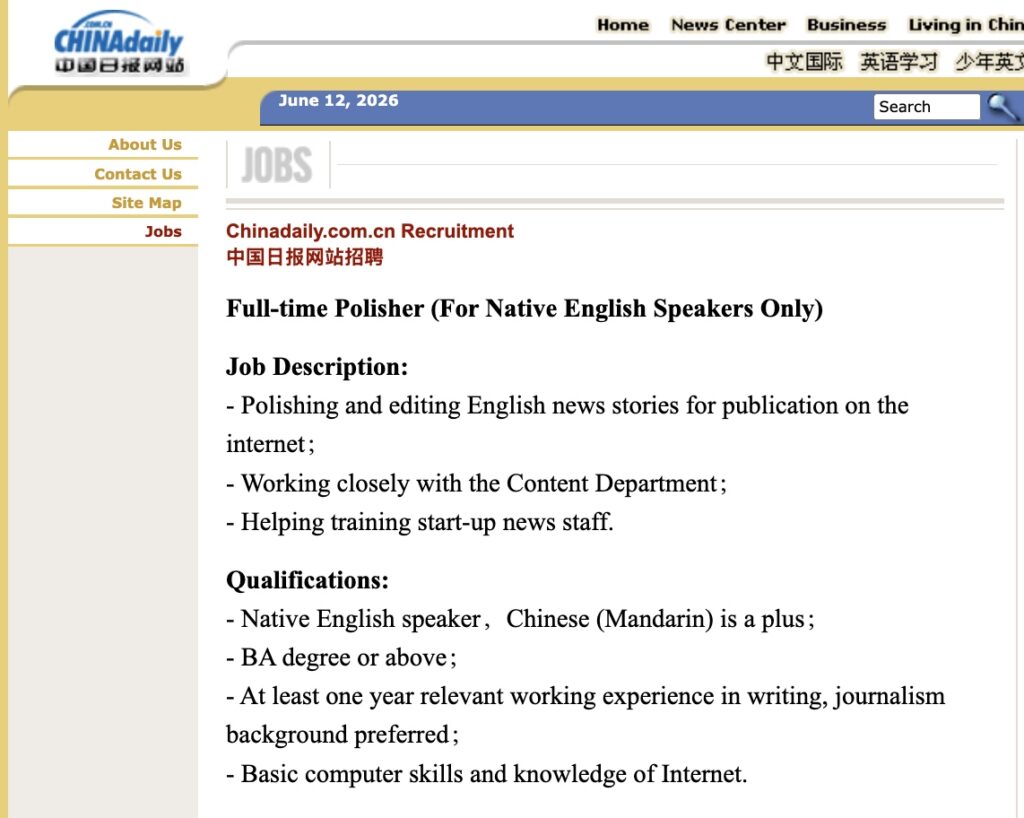
Pauken is not an isolated case of Americans being deployed by Chinese intelligence to do their dirty work in the United States. There have been others who have been involved in industrial and political espionage for China. Nevertheless, as insidious as his action was, my attention to him was drawn by another fact — his cover in China was working for Chinese state media outlets like Xinhua, China Radio International, China Central Television and China Global Television Network (CGTN).
Seeking recourse to a pseudonym “Tom McGregor” (on the suggestion of his father Thomas Pauken, a politician from Texas), he has written many articles in English for Chinese state media outlets. While it’s not unusual for journalists to find work in different media outlets in countries other than their own, the difference with “McGregor”/Pauken was that rather than serving as an impartial journalist, he let himself be a tool in the Chinese government’s campaign to reshape its global image.
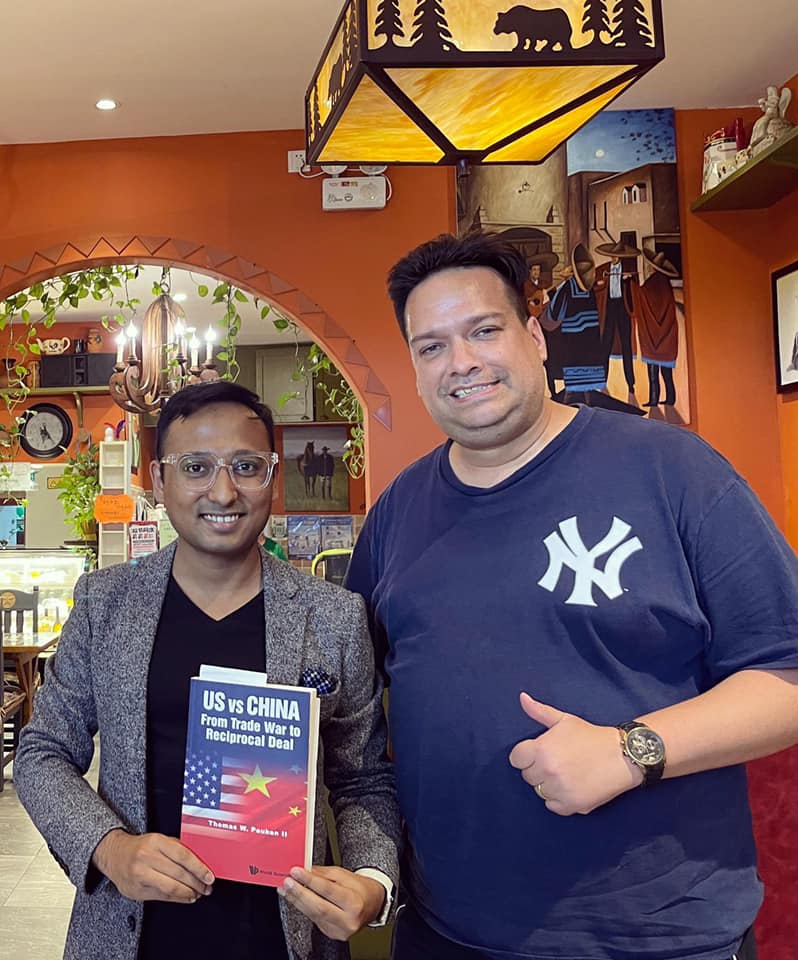
Thomas Pauken with Shamin Zakaria a journalist from India who also works for Chinese state media.
In particular, McGregor has written several articles on Tibet trying to alter the global narrative on major issues of interest. His writings are thus part of China’s strategy of utilizing foreigners, including journalists and influencers, as part of its disinformation machinery.
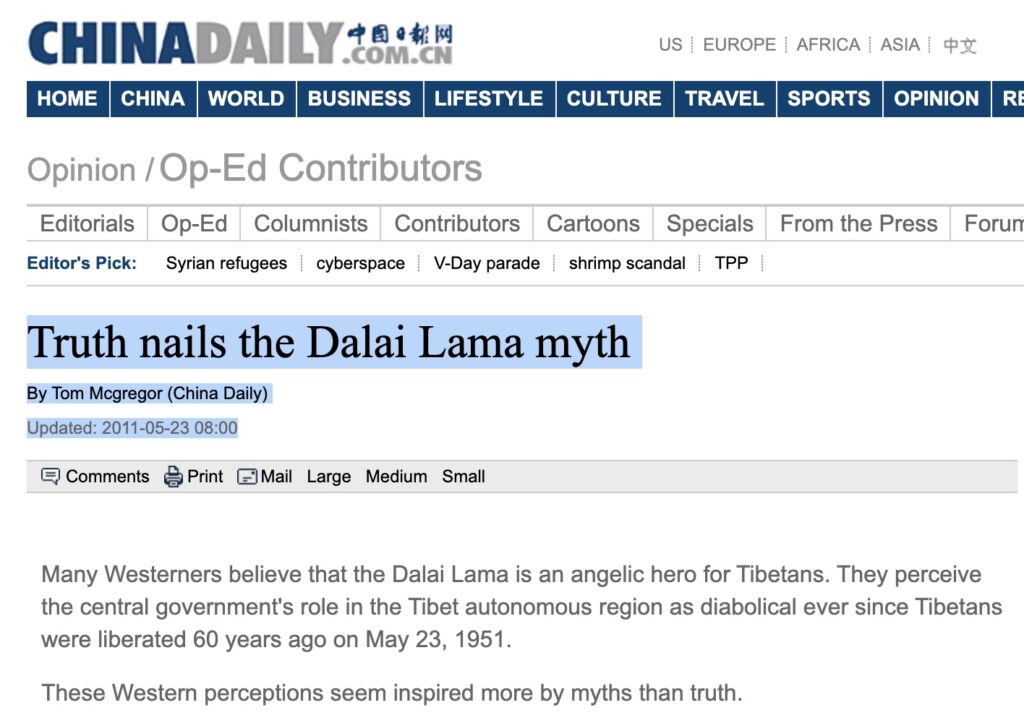
In the case of Tibet, one of China’s main efforts is to undermine the credibility of His Holiness the Dalai Lama and to project a positive image of Chinese rule in Tibet. Pauken was tasked with an article for the official China Daily on May 23, 2011, where he wrote as McGregor under the headline, “Truth nails the Dalai Lama myth.” He mused, “Many Westerners believe that the Dalai Lama is an angelic hero for Tibetans. They perceive the central government’s role in the Tibet autonomous region as diabolical ever since Tibetans were liberated 60 years ago on May 23, 1951. These Western perceptions seem inspired more by myths than truth.”
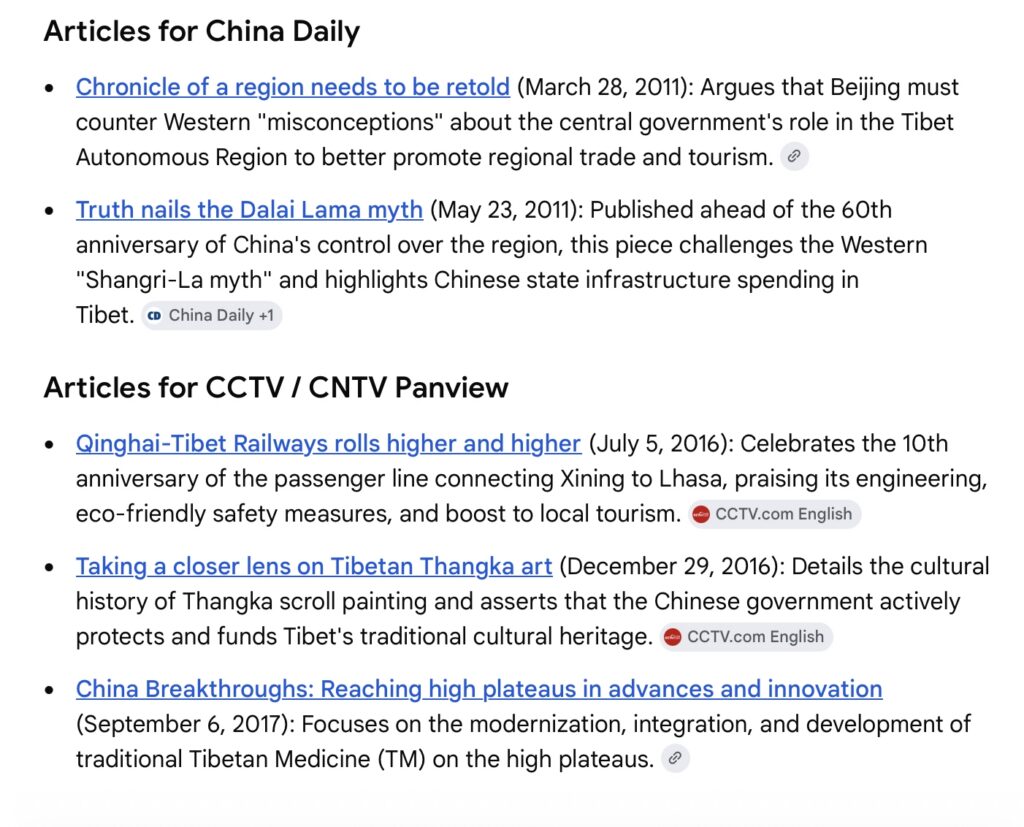
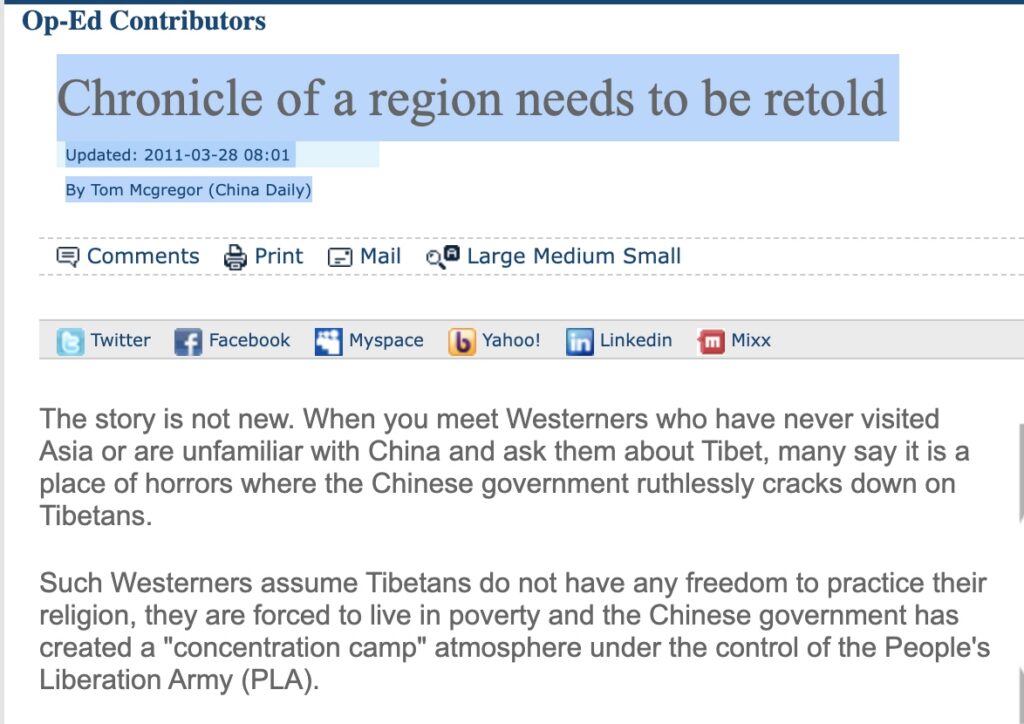
Another Chinese propaganda campaign is to discredit Tibet before China’s occupation as something horrible and barbaric and to present Tibet under Chinese rule as free and prosperous. McGregor was also used for this objective, writing several articles in China Daily in March 2011 under the headline “Chronicle of a region needs to be retold.” One article on March 28, 2011 begins, “When you meet Westerners who have never visited Asia or are unfamiliar with China and ask them about Tibet, many say it is a place of horrors where the Chinese government ruthlessly cracks down on Tibetans. Such Westerners assume Tibetans do not have any freedom to practice their religion, they are forced to live in poverty and the Chinese government has created a ‘concentration camp’ atmosphere under the control of the People’s Liberation Army.”
Similarly, in an article for the official Chinese propaganda outlet CCTV on September 14, 2018, McGregor includes Tibet in “Western China” and writes, “Western China has just entered a more prosperous stage and many people in the region are likely to share the spotlight and enjoy the limelight of having better jobs and higher incomes for many more years to come.”
The Chinese government has a history of using foreigners to spread its false narrative. In the 1970s and 1980s, Israel Epstein from Poland and Americans such as Felix Greene, Anna Louise Strong and Edgar Snow were actively wooed by Beijing and became their mouthpiece to the outside world.
In 1993 in a two-day “Conference on the Work of the External Propaganda on the Question of Tibet” held in Beijing, Chinese officials outlined the Chinese Communist Party (CCP)’s coordinated efforts to counter international pressure by controlling narratives, sanitizing regional conditions, and manipulating media coverage. Leaked proceedings of the meeting showed the Chinese saying, “By arranging foreign journalists and other people to go to visit Tibet we should be able to use foreign forces to carry our external propaganda and gradually change their mind about us through what they have seen with their own eyes.”
In recent years, the Chinese authorities aggressively recruited foreigners to be part of its state media team so that, both linguistically and psychologically, the Chinese propaganda would be better shaped for the international community. A partial list of such individuals include Australian Edwin Maher, said to be the first non-Chinese news anchor for CCTV; Andy Boreham, New Zealander working for Shanghai Daily; American Jonathan Aaron Alpart, who worked for China Radio International commenting on his work there saying, “It was all soft propaganda about tourism, how cool China is”; and Indian Shamim Zakaria who presents himself as Associate Editor at Xinhua. No matter what position such individuals are hired for, many of them end up either personally writing their “impressions” about China or being “interviewed” by Chinese state media about their perceptions.
With the advent of social media, Chinese authorities have been promoting their narrative on Tibet through foreign influencers. Select group of Youtubers from abroad are provided access to Tibet and they end up presenting a sanitized version of the conditions of the Tibetan people. Some of them do admit the restrictions imposed on them and the issues that could be considered normal in China proper but are not allowed to be taken up in Tibet.
The broad nature of Chinese strategy on this issue can be seen from the remarks made by Li Ganjie, head of the CCP’s United Front Work Department. Speaking to researchers who had gathered to mark the 40th anniversary of the China Tibetology Research Centre on June 4, 2026, Li said, “Chinese academics specializing in Tibet must find more creative ways to shape the global conversation about the region while remaining strictly aligned with the Communist Party’s ideology.”
More interestingly some China-based foreigners, who have businesses there but use social media as a side business, are also roped in to spread the CCP gospel. One such individuals is Daniel Dumbrill, a Canadian who has quite a few businesses, including brewery in China and is also an active YouTuber.
Dumbrill is one of the foreign social media influencers who are being used by the CCP, according to a report, “Borrowing mouths to speak on Xinjiang” in 2021 by the Australian think tank Australian Strategic Policy Institute (ASPI), for its “global propaganda push” to whitewash human rights abuses. The report says, “All of these influencers [many others have been named in addition to Dumbrill] have been directly referenced by MOFA [Ministry of Foreign Affairs] officials on social media or in party-state media articles, and both Daniel Dumbrill and Barrie Jones have had their videos shown at MOFA press conferences.”
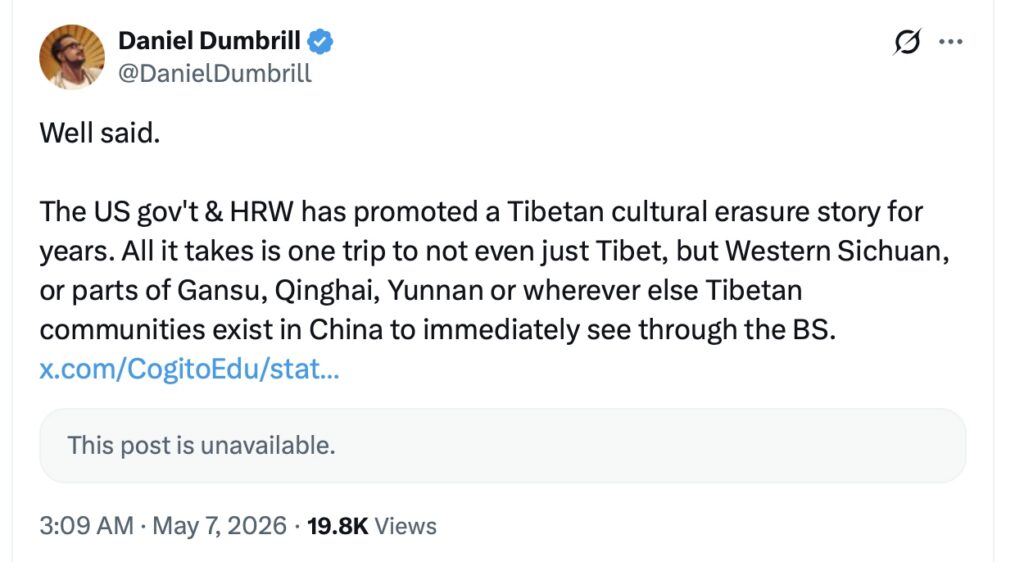
Even on Tibet, Dumbrill has been actively promoting viewpoints that align with the official party line as promoted on his twitter feed, including the following despite knowing how China makes it virtually impossible to travel to Tibet.
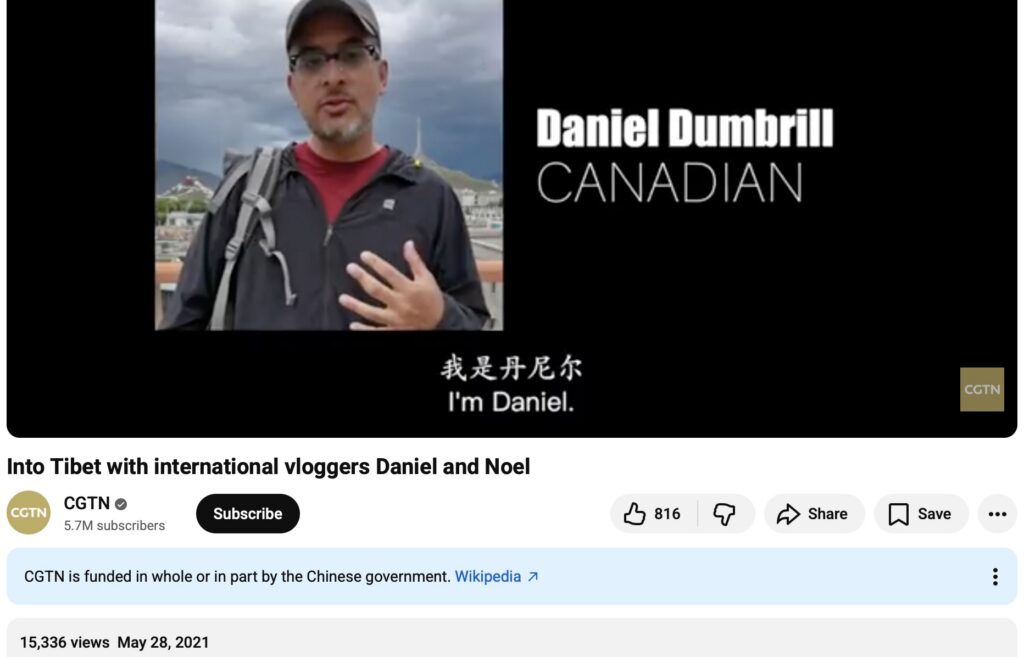
Dumbrill has frequently partnered with Chinese state media like CGTN to create video content providing a one-sided image of Tibet. Even though he presents himself as an independent observer, he lets himself be part of Chinese state media propaganda trip to Tibet. During one such trip, he was promoting official lines about the state of Tibetan Buddhism in real time on Twitter and I took the opportunity to challenge him on a few assertions, including on him being part of the CCTV-sponsored trip. In all likelihood, Dumbrill’s action could be a way for him to secure the safety of his business in China. One online commentator on Dumbrill called him “a more sophisticated propagandist—he knows how to make propaganda look reasonable. He knows what things he needs to avoid doing in order to maintain credibility.”
Understanding this Chinese disinformation campaign on Tibet, the United States Congress has come out with legislations and policy statements. The Promoting a Resolution to the Tibet-China Dispute Act, passed by Congress in 2024, mandates that US public diplomacy efforts should “counter disinformation about Tibet” from the Chinese government and Communist Party, including “disinformation about the history of Tibet, the Tibetan people, and Tibetan institutions including that of the Dalai Lama.”
The annual Tibet Lobby Day, which was held from June 8 to 9, 2026 saw more than 225 Tibetan Americans and supporters visit their congressional offices in Washington, D.C. and elsewhere calling for strengthening of American support on Tibet. They called for increased America engagement with the legitimate Tibetan leadership — the Central Tibetan Administration in Dharamsala — through passing the Assuring the Future of Tibet Act of 2026. They also urged for the passage of the Tibet Atrocities Determination Act that would require the Secretary of State to investigate China’s repressive actions in Tibet and publicly report on whether those atrocities meet the criteria for genocide or crimes against humanity.
Such legislations aim at directly challenging Chinese Government’s efforts to undermine the Dalai Lama and the Tibetan leadership in exile, including through foreigners like Thomas Pauken who virtually end up being the mouthpiece of China.