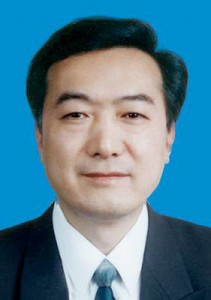
Tibet Autonomous Region Party Secretary Chen Quanguo
First, here is a summation of the report. The official Tibet Daily carries a report on November 5, 2014 about the findings of an inspection team of the CPC Central Commission for Discipline Inspection (CCDI), which was in the Tibet Autonomous Region from July 25 to September 24, 2014. It quotes Ye Dongsong, head of the inspection team, as saying, “Some officials have failed to take a firm political stand and some grass-root officials in the region were found to have serious corruption issues.” Apparently, the team collected the information by “interviewing some people, receiving letters from the public, receiving phone calls, personal visits, and looking at and reading relevant documents.”
It is good that the authorities are finally realizing something that has been an open secret among Tibetans in Tibet for many decades; corruption is rampant and even routine tasks that are expected from any official cannot be performed without going through the Takgo (“back door”). Therefore, finding “serious corruption issues” will not be a surprise to the Tibetans, but they will now be waiting to see how the authorities will be following up on this. Ye is quoted as reiterating that on the issue of anti-corruption campaign, Tibet will not enjoy any special privileges. But a belief among the Tibetan public is that the authorities will not be prosecuting any of these officials as they are also the ones who mouth slogans of loyalty to the Chinese Communist Party. So far the trend is for the authorities to specifically reward those officials who are criticized by the public because this was taken as an indication that these officials are upholding party lines (and conversely demote those who are praised by the people).
The Tibet Daily reports Chen Quanguo, Party chief of the Tibetan Autonomous Region, as accepting the team’s findings saying that they were “factual and comprehensive” and have “woken us up from the sleep of ignorance.”
Chen then expands on the situation saying that the anti-corruption campaign should be coordinated with the anti-separatism campaign. He is reported as saying that one hand should uphold the anti-corruption campaign and the other hand should uphold the anti-separatism campaign.
Now here comes the interesting part. Chen is reported as saying, “Those cadres and officials who harbor fantasies about the 14th Dalai Clique, follow the 14th Dalai Clique, participate in supporting separatist infiltration sabotage activities will be strictly and severely dealt with according to the law and disciplinary rules.” Chen adds that they should not be Go-nyima (“dual headed”).
If there was any doubt on why Chen Quanguo was saying this, it was clarified by a Chinese professor to the official Global Times on November 5. “Some officials in Tibet still sympathize with the Dalai Lama. They continue to support the Dalai Lama out of their religious beliefs,” said Xiong Kunxin, a professor with the Minzu University of China. The professor also adds, “… those officials also support the Dalai Lama’s separatism activities.”
The findings of China’s inspection team and the admission by Chen Quanguo that even cadres are looking to the Dalai Lama instead of to the Communist Party confirms the reality that despite all their efforts the Chinese authorities have not been successful in severing the historical and special bond between the Tibetan people and the Dalai Lama.
China has always attempted to make the world believe that everything is fine in Tibet, and that the Tibetan people are happy under the Communist rule. They even claim that “Earth-shaking changes have taken place in Tibet since the peaceful liberation 60 years ago.”
But the latest report confirms what the Tibetans knew all along; their steadfast devotion to the Dalai Lama and the existence of corruption at all levels in the Tibetan society in Tibet. The sooner the Chinese Government acknowledges these and positively addresses them, the better it is for China and Tibet.