July this year began on a somber note for the Tibetan people. On July 1, 2026, China’s widely criticized Ethnic Unity and Progress Law came into effect, posing a real risk of acceleration of the erasure of Tibetan identity in Tibet. Therefore, Tibetans and supporters in the free world engaged in activities to denounce the law and to express their concern. The strong Tibetan reaction to the law was fundamentally because it brought into the open something that Tibetans knew the Chinese government has been aggressively implementing in Tibet over the past several years.
However, the next few days were going to be the long weekend in July that we in the United States look forward to. For Tibetan Americans, it is a double celebration period; in addition to celebrating American Independence Day on July 4, we also celebrate the birthday of His Holiness the Dalai Lama on July 6, with community gatherings this year for his 91st birthday.
But on the evening of July 2, 2026, commuters on First Avenue, in front of the United Nations headquarters in New York City, and people online, were witness to Lobsang Palden la (more popularly known to his acquaintances as Lobga Rangzen), a 52-year-old Tibetan in New York, committing self-immolation. Rangzen is the Tibetan term for independence, which he adopted as his public persona symbolizing his political conviction.
In the initial moments, many of the passersby or those online would have been confused, not fully comprehending what they were seeing. In fact, the first version of the online report by the New York Post was headlined, “Lunatic with Tibetan flag sets himself on fire outside NYC’s UN headquarters”. Subsequently, they corrected the website version. In any case, the journalist who formulated the initial headline may only have been reflecting the assumption that anyone deciding to give up one’s precious life in such a way is not of sound mind. It was a failure on the part of the journalist concerned to understand that doing so for a cause shows one’s courage of conviction.
To those who recognized the Tibetan national flag, even without knowing the identity of the self-immolator, it was clear that this act had something to do with Tibet.
It was only after seeing the video message Lobga Rangzen had posted before his courageous action that things became clear. In the more than 160 self-immolations by Tibetans since 2009, virtually no one had been able to leave a direct video message like this before carrying out their action.
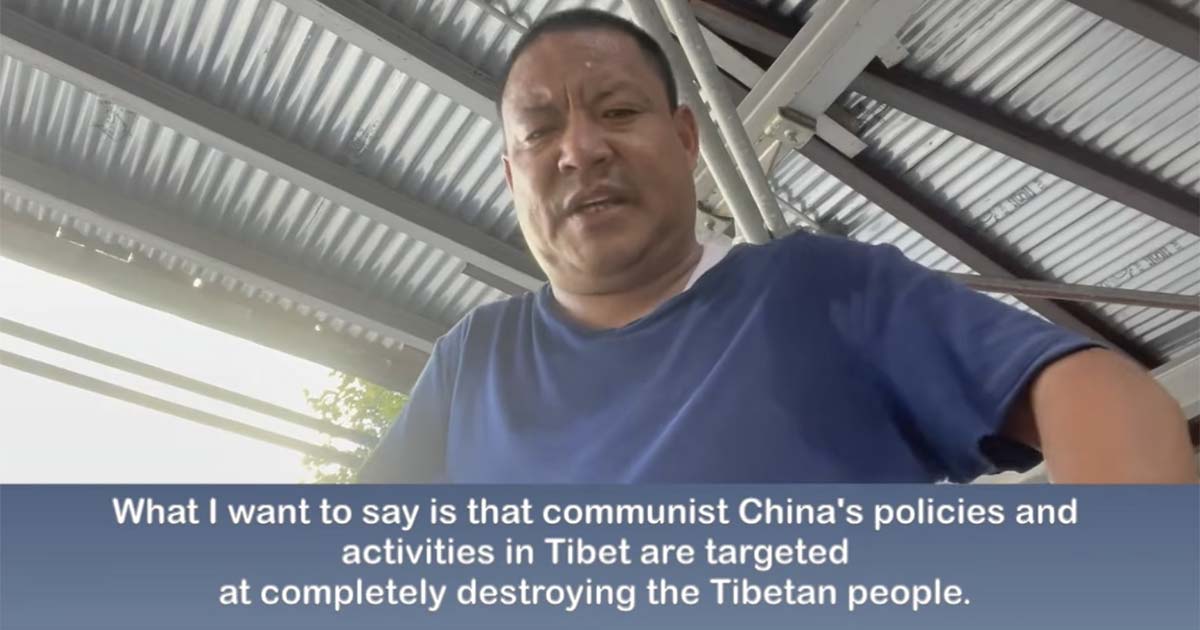
Screenshot of the video Lobga Rangzen posted on his Facebook before his self-immolation on July 2, 2026.
In a clear and calm tone, Lobga first had a message for Tibetans in the video: “Today, when we say that we do not have human rights, that we do not have freedom of speech, that we do not have the freedom to display a portrait of His Holiness the Dalai Lama – if we examine why we do not have these freedoms, it is because we lost the independence of Tibet.”
He continued, “Therefore, from today onwards without arguing about our province or religious denominations, we should think of ourselves as Tibetans. I am a Tibetan (raises fist). Some of us say we do not have independence. It is not that we do not have independence; we have independence, but that independence was lost. We have to regain our independence. Therefore, we Tibetans in exile must unite and struggle for the independence of Tibet. I want to appeal with folded hands to our exile community to work towards this.”
Cathartic moment of the Tibetan struggle
One way to analyze the self-immolation is to see it as part of the cathartic moment that also led to the series of self-immolations in Tibet that began in 2009. China’s misrule in Tibet and the increasingly discriminatory restrictions imposed on the Tibetan people have left them with no space to air their grievances. As Kirti Rinpoche, the abbot of the Kirti Monastery in Ngaba in north-eastern Tibet, the region where the majority of the self-immolations in Tibet have taken place, mentioned during his testimony to the Tom Lantos Human Rights Commission of the US Congress in 2011, Chinese rule has caused a wound that spans three generations of Tibetans: the destructions and persecution during the Long March period in the 1930s; during the invasion and occupation in the 1950s; and in the 1990s and subsequent years, including the period of Strike Hard and Patriotic Education campaigns. Referring to the self-immolations in his region, Kirti Rinpoche testified that “these were just the pus coming out of the wound that has been inflicted on all Tibetans” by the Chinese Communist Party.
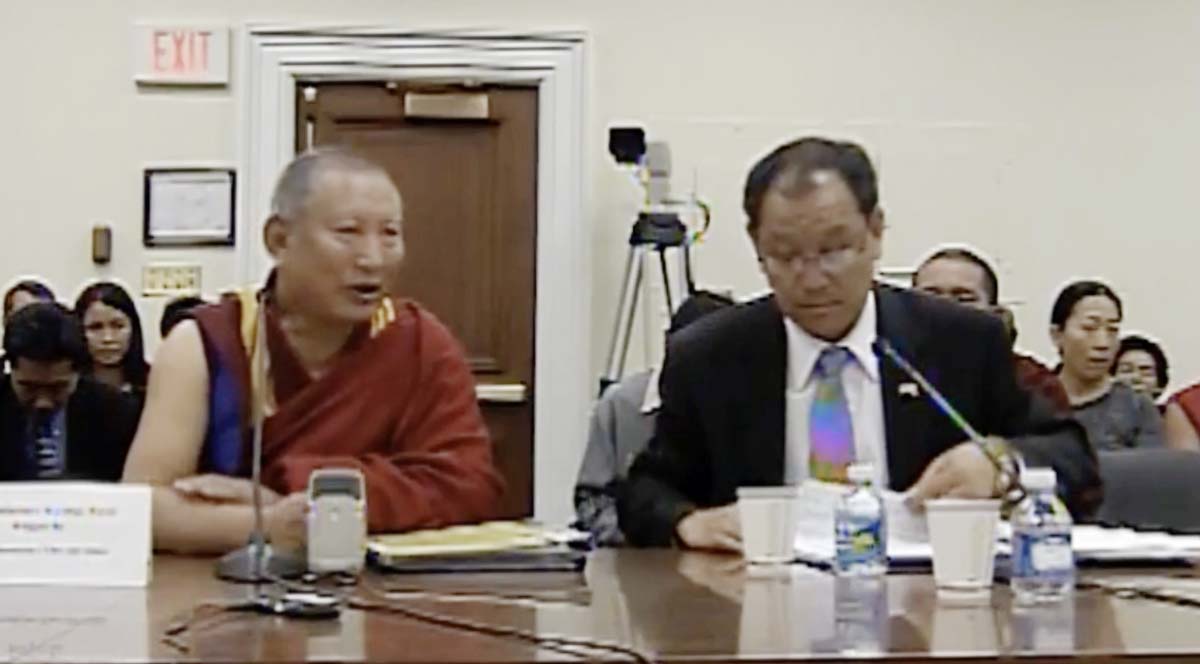
Kirti Rinpoche at the Tom Lantos Human Rights Commission Hearing on Tibet in November 2011. I had the privilege of translating for him.
The fact that the wound continues into the next generation of Tibetans could be seen from the age group of the Tibetans who were the main participants of the demonstrations and the self-immolations in Tibet in the 2000s. Almost all of them were born under the Chinese Communist rule, supposedly belonging to a “liberated” Tibet. They had no experience of life before the Chinese occupation and, logically, should have been happy under the “socialist paradise” that China claims.
“This wound is very difficult to forget or to heal,” Kirti Rinpoche said in his testimony, referring to the traumatic consequences of the Chinese occupation of Tibet. The latest self-immolation can certainly be seen as testifying to this difficulty aspect of healing the wound of the Tibetan people.
Religion has a central role in Tibetan society, and by resorting to the destruction of Tibetan Buddhism as a way to subdue the Tibetan people, the Chinese authorities have unleashed more than 60 years of humiliation. It is for this reason that a common term Tibetans use for the Chinese Communist is “Tenda Gyamar” or “Enemy of the Faith, Chinese Communists.”
The new Chinese law, Promoting Ethnic Unity and Progress Law, along with its preceding regulations in different regions of Tibet, was perceived by Tibetans as a cause for concern and apprehension, including the danger posed by Sinicization of Tibetan Buddhism. Tibetans in exile and the Tibet movement as a whole (since Tibetans in Tibet have no space to express their real feelings on it) have been greatly concerned ever since news about the impending law became public, highlighting its threat to the very survival of Tibetan identity in their own homeland. Thus, the timing of the self-immolation, on July 2, 2026, assumes significance as it occurred one day after the consequential law came into effect. Having been long involved in Tibetan activism, primarily in his adopted home of New York, among other places, Lobga la was affected by the implications of this law, as can be understood from his video message.
UN and justice for Tibetans
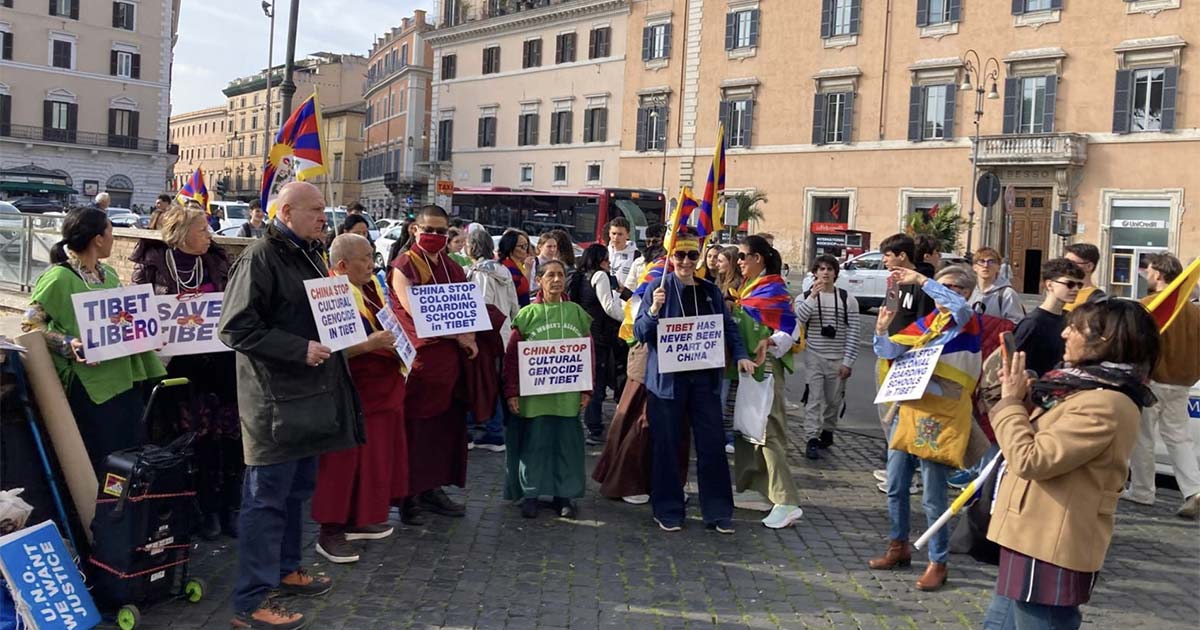
A “UNO We want Justice” placard lying on the ground at a rally for Tibet in Rome, Italy, on March 10, 2026.
It is not just Tibetans or other communities like the Mongolians or Uyghurs who see this law as a threat. The UN High Commissioner for Human Rights Volker Türk called for the law’s repeal in his update to the Human Rights Council on June 15, 2026. Even before that, eight United Nations special mandate holders issued a joint statement in April asserting that the law “…could transform temporary or experimental regional measures into binding nationwide obligations, which could have serious implications for the linguistic, cultural, and religious autonomy of ethnic communities, including Tibetans, Uyghurs, and Mongols.” But the United Nations itself has become comparatively reticent on matters concerning China, and Secretary General António Guterres has not yet spoken out on the law.
Thus, Lobga’s choice to self-immolate before the UN in New York was a strong message to the international community. Right from the time of the initial Chinese invasion of Tibet and its subsequent occupation, the Tibetan people have placed tremendous hope in the ability of the UN to stand up for their rights. In their memo to the UN on November 7, 1950, the Tibetan Cabinet wrote, “We Ministers, with the approval of His Holiness the Dalai Lama, entrust the problem of Tibet in this emergency to the ultimate decision of the United Nations, hoping that the conscience of the world will not allow the disruption of our State by methods reminiscent of the jungle.”
The UN declined to act. The situation in Tibet worsened leading to the flight of the Dalai Lama into exile in India, along with around 80,000 Tibetans. But hope was still placed in the UN. In September 1959, His Holiness the Dalai Lama himself wrote to the then UN Secretary General Dag Hammarskjold appealing to the UN to help save the Tibetan people. Appeals were also made to other countries. Subsequently, the UN General Assembly did pass three resolutions on Tibet, including affirming that Tibetans have “their right to self-determination.”
But there has been no follow-up action at the General Assembly level, let alone at the Security Council, since the last resolution in 1965. Subsequently, the Tibetan issue was more or less left in the domain of human rights and discussed, if at all, in Geneva.
Yet Tibetan hope that the UN will support their cause continues. To this day, almost at every Tibetan rally in the free world, one of the main slogans continue to be “UNO, we want justice!”
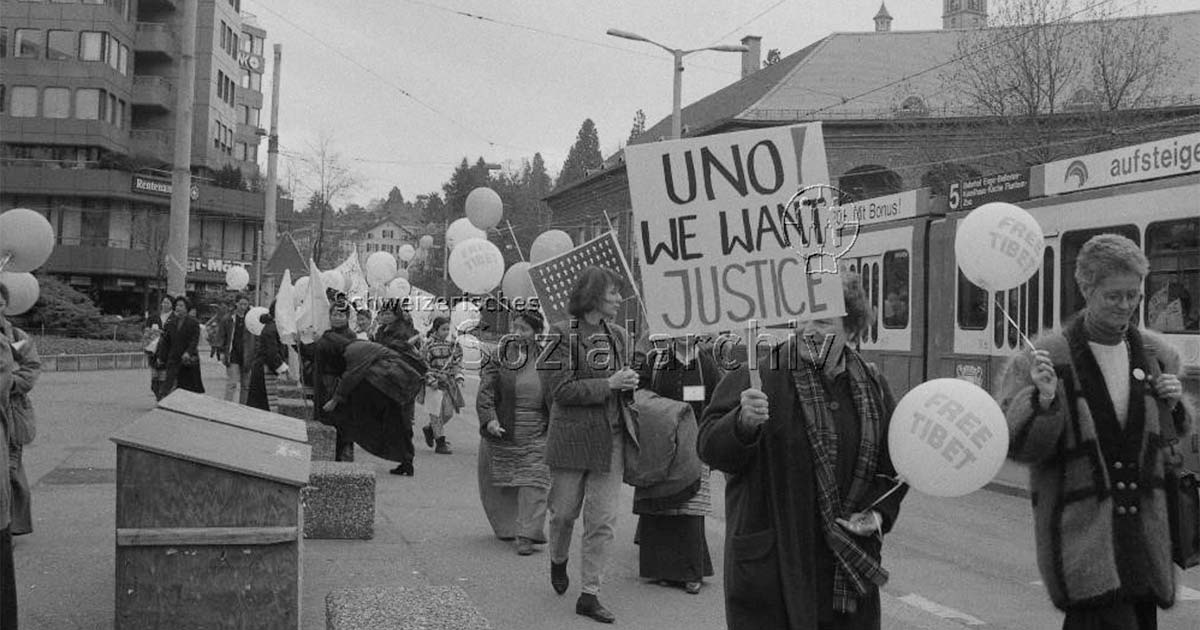
A rally on Tibetan Women’s Uprising Anniversary on March 12, 1994 in Zurich Switzerland with a protester holding a “UNO We Want Justice” placard.
Therefore, by self-immolating before the UN headquarters in New York, Lobga was appealing to the highest level possible in the global political system. We can see what the UN’s position is on this based on the response that a UN Spokesperson gave to a question posed by a journalist about the Lobga Rangzen self-immolation at a media conference on July 6, 2026. When asked for his comment, Spokesperson Stéphane Dujarric said, “Listen, it’s hard to imagine what would propel a human being to do that to themselves. On the broader issue, I think for us, and the Secretary-General said this many times, that in any country, it is important that minorities are respected and that they are also made to feel as part of the whole.”
Tibetans believe in the justness of our cause. In fact, the objective of the Tibetan struggle is termed བོད་དོན་བདེན་མཐའ་གསལ་བ། (“Bodhon dhentha selwa” which means “having a clear end to the truth of the Tibetan issue”). His Holiness the Dalai Lama has said, “At present the Tibetan struggle is between the power of truth and the power of the gun. In the short term the gun seems more powerful, but in the long run truth is more important and more effective.”
Despite the politics that goes into the UN’s workings, Tibetans continue to believe that the UN has the capability of supporting truth and justice. The UN itself talks about its objectives, saying, “Rather than simply reacting to crisis, peacebuilding addresses the fundamental root causes of conflict – poverty, inequality, and injustice – to help communities build lasting stability.” The challenge is to see how the UN can intervene in the Chinese government’s attempts to deny these rights to Tibetans, including that of their very existence as a distinct community.
Implication for the future direction of the Tibetan movement
One reference in Lobga Rangzen’s video statement could be perceived as indications of how the future direction of the Tibetan movement might be determined. I am referring to his mention of His Holiness the Dalai Lama and differentiation between how he (because “he is Buddha”) approaches issues from a broader perspective, taking into consideration humanity as a whole, versus how an average Tibetan does. He then makes this statement: “But we are not Buddha, we are human beings. Today, what I have to say is that the Chinese Communists have persecuted all of us, Tibetans, irrespective of whether we belong to Dotoe, Domed or Utsang province (the three traditional provinces of Tibet).”
On the face of it, it is a call to action, as he was saying that while His Holiness can be more considerate, we ordinary Tibetans cannot and should not be so. At another level, this statement shows how the current Tibetan struggle, including its path of non-violence, is shaped by the person of His Holiness. His authority — spiritual, moral and even political — is adhered to by all Tibetans, in Tibet and in exile. If at some point in the future when His Holiness is no longer present and the Tibetan issue has remained unresolved by then, the direction of the struggle will be determined without his counsel. The implication of such a development is a matter for consideration by the Tibetans, the Chinese government as well as the international community.
Hope is an essential part of the non-violent Tibetan struggle. Today, whether it is the courage and determination of the Tibetans in Tibet or the peaceful struggle by the Tibet movement in the free world, it is His Holiness the Dalai Lama who gives them hope.
When hope is lost, it can become uncontrollable. Tibet has so far remained free of being a major international violent crisis. It is in the hands of the international community to ensure that there is a resolution to the Tibetan cause at the earliest by proactively supporting the Tibetan struggle. Tibet should not end up becoming another global flashpoint.
What next?
As I write this, people are still in a state of shock and trying to process everything. Among Tibetans, emotions are strong and people are looking for ways to express them. In addition to community prayers, there are rallies, hunger strikes, and an outpouring of sentiments, in audio, video and text form across various mediums, including on social media. The self-immolation has become the trigger for the Tibet movement to introspect.
For the international community, this development serves as another reminder that the long-drawn-out struggle of the Tibetan people has not seen a resolution and is also an urgent call to action for them to urge their governments and the UN to word towards one.