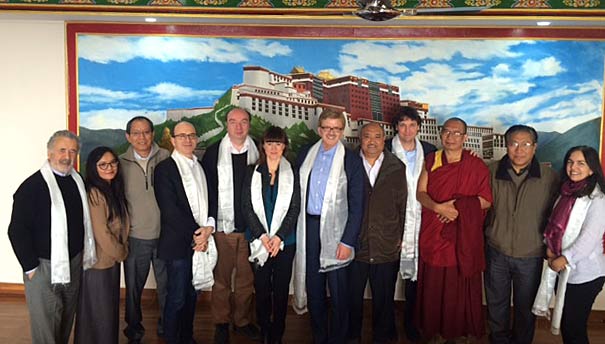
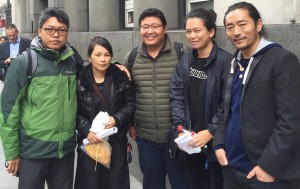
Tibetan Election Observation Mission members with the Tibetan election commissioners in Dharamsala on March 19, 2016.
On April 27, 2016, the Tibetan Election Commission announced the results of the Sikyong and parliamentary elections. Except in the case of some members of parliament, for the Sikyong and some other MPs, the results were already known and this is a mere formality.
There have been some discussions about the degeneration of the Tibetan society in diaspora in the months leading to the elections, with now even the politicians realizing their shortsightedness. There have been some damage but all is not lost in the broader scheme of things. In the past when there were concerns about his devolution of authority, His Holiness the Dalai Lama had said it is better that the people tread on this path of self-reliance while he was still active as he can then provide guidance if things go astray. Therefore, the recent development was something that would have happened at any time given the nature of the system and it was good that it happened now while corrective measures can be taken.
In any case, I wrote the following after the previous election cycle in 2011. Upon re-reading it, other than there being a change in the nomenclature from “Kalon Tripa” to “Sikyong” the rest of my assertion continues to be valid for the new administration under Sikyong Lobsang Sangay. Therefore, I am reposting it.
Message from the Tibetan Elections
Bhuchung K. Tsering
April 27, 2011
Today, the Tibetan Election Commission in Dharamsala, India, announced the results of the general elections held on March 20, 2011 to elect the Kalon Tripa, the Chairman of the Tibetan Cabinet, and members of the Tibetan Parliament. As pointed out in the statement our organization issued today, congratulations are due not just to the winners but also to all the Tibetan people who participated in this historic democratic process. Above all, this is yet another testimony to the foresight of His Holiness the Dalai Lama in his several decades-long efforts at democratizing the Tibetan governances system.
When campaigning began for the present election cycle in 2009, I wrote the following about what the next Kalon Tripa’s responsibilities would be.
“The next Kalon Tripa should devote his or her time and effort to the consolidation of the Tibetan community, becoming their spokesperson and look into creation of a system providing a continuation of leadership.
“There are three main ways to implement this provision of political leadership.
“First, the position needs to understand that the basis of the Tibetan people’s support to the leadership currently is the historical role of the institution of the Dalai Lamas. The next Kalon Tripa needs to work on a strategy to continuing this relationship and to strengthen the institution to prepare for any and all eventualities.
“Secondly, the Kalon Tripa needs to be the seen as the leader of all Tibetans and not just of the hundred thousand or so Tibetans in exile. The strength of the Tibetan leadership under His Holiness the Dalai Lama today is that it enjoys the loyalty and support of the broad majority of Tibetans who are in Tibet. The millions of Tibetans in Tibet have shown this in different ways, time and again. The next Kalon Tripa needs to find creative ways to strengthen this special bond between the Tibetan people and the leadership.
“Thirdly, the next Kalon Tripa needs to clearly comprehend the reality of the position in terms of relationship with the international community and the governments throughout the world, including that of India. Accordingly, he or she needs to come up with a strategy to secure the formal or de facto acceptance by the governments as a spokesman for the Tibetan people. He or she needs to be able to stand on his or her own feet (think beyond the structure of Dharamsala) and be recognized as being on the helms of the Tibetan leadership by the international community.”
I had written the above before there was any inkling of His Holiness the Dalai Lama deciding to devolve his political authority to an elected leadership. Now that we are faced with this new reality, Kalon Tripa-elect Lobsang Sangay la as well as our newly elected parliamentarians have greater responsibilities than before. I would urge them to think on the above points as they prepare to take charge.
As I write this, Lobsang Sangay la has, while speaking to Voice of Tibet about the election results, opined that one individual alone would not be able to do much but that he would work to the best of his ability. I believe team work is certainly something that needs to be given serious consideration as the new Kalon Tripa begins his work. Secondly, Lobsang Sangay la also said that his election is a strong message to China that under the guidance of His Holiness the Dalai Lama a new generation has taken responsibility. The Kalon Tripa-elect also went live on Radio Free Asia and Voice of America Tibetan services in Washington, D.C. today expanding on his views.
As for China, the authorities seem to have already got the message from the Tibetan elections and there is an article today entitled “On 14th Dalai Lama’s view of ‘political reform’ “ that is very defensive of the Chinese system. Given that the Chinese system does not permit Tibetans in Tibet to have a direct say in who becomes their leader (for that matter even Chinese do not have that right), the Chinese authorities cannot have the courage to welcome the positive message that the tiny Tibetan community in exile is sending in terms of political governance.
The international community, as reflected through the media coverage, has shown great interest in this Tibetan democratic process. It remains to be seen how the governments will react to the new reality and the new Administration in Dharamsala. There is continued public support whether in the United States, Europe or elsewhere to the just cause of the Tibetan people and the political leadership in all the countries would need to keep this in consideration as they try to frame a new approach to the Tibetan issue.
My Tashi Delek to all the winners in this election and wish them all success as they begin their work for the wellbeing of the Tibetan people.
Serious questions are raised by the lecture on 4th December at EIAS by a Chinese Communist Party official who has been notable for his attempts to stifle independent debate and adherence to aggressive policies against the Dalai Lama.
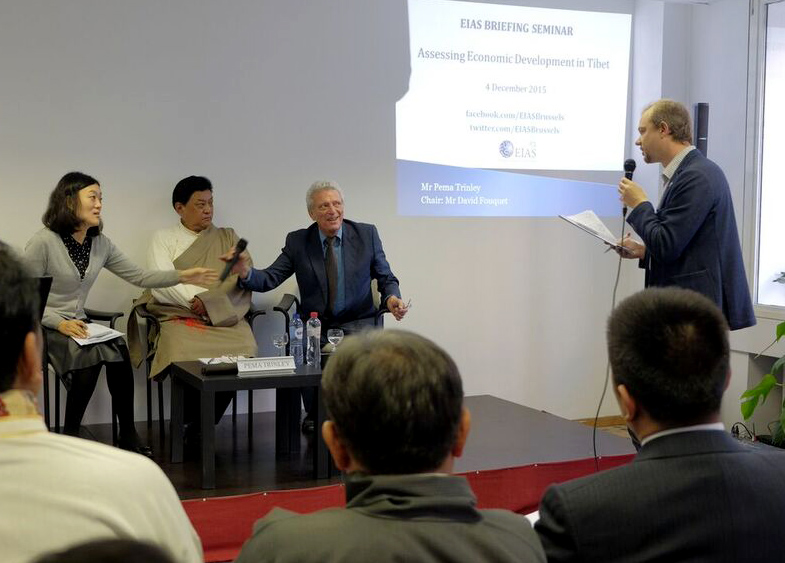
Vincent Metten (ICT) asking questions during the Q&A Sassion. On the panel from left to right: the chinese interpreter, Mr Pema Thinley and EIAS moderator Mr Fouquet.
Pema Thrinley (Chinese transliteration: Baima Chilin) the Vice Chairman of the Ethnic Affairs Committee, National People’s Congress of China spoke about “Assessing Economic Development in Tibet”. We believe that this is in direct contravention of the mandate of the European Institute for Asian Studies, as a “leading Brussels-based Think Tank and Policy Research, which provides a platform for the promotion of dialogue and understanding between the European Union and Asia on affairs of strategic regional and global importance, hereby ensuring indepth, comprehensive research and information exchange.” (www.eias.org)
Pema Trinley served in the People’s Liberation Army based in Tibet from 1969 to 1986, a military career which could be as an important credential for the continued implementation of harsh security policies in the region that have become the norm for the Party in handling Tibet. He is seen as a man who had played a prominent role in justifying the crackdown on Tibetans after the March 2008 protests in the Tibetan capital city, Lhasa. This year Pema Trinley accused the Dalai Lama of “profaning religion and Tibetan Buddhism” as a reaction to Dalai Lama’s remarks that he might not be reincarnated when he dies.
The decision by EIAS to invite this official delegation also appears contradictory in the light of its recent decision to reject a discussion with an authoritative independent expert on Tibet’s environment, a matter of regional stability and increasing global concern.
The International Campaign for Tibet (ICT) contacted the EIAS and proposed them to host an event with an expert in environmental issues in Tibet, Mr Gabriel Lafitte, a researcher in the Department of Management, Faculty of Business and Economics, of Monash University, in Australia, and editor of a specialist website www.rukor.org which focuses on Tibetan encounters with global modernity.
EIAS responded to the proposal as follows: “After discussing internally, and while unfortunately organizing a public seminar on Tibet is not possibility for EIAS, we would be very interested in having an internal meeting with Mr Lafitte, should he be interested (together with some of our senior associates and researchers).”
Very surprisingly, a few weeks later we received an invitation from the same organization to attend a Briefing Seminar on Tibet by Pema Thinley as the main speaker.
During the Q&A Session, I asked why the Institue had changed its attitude towards Tibet and has now included it on its agenda, EIAS’ “moderator” Mr David Fouquet answered: “Even in small organisations, there can be bureaucratic misunderstanding and miscommunication. I was not involved in process you describe, but we can maybe talk about it later with the person you were in contact with. My approach would be that it would have been a possible topic of interest.”
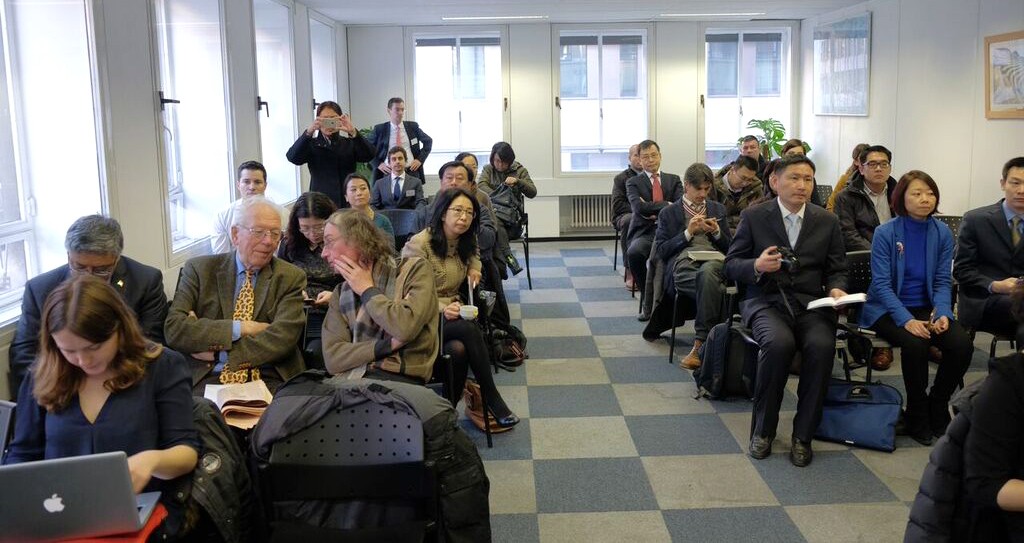
Participants to the EIAS Briefing.
The diplomat from the Chinese EU mission trying to prevent me from taking pictures.
I was also quiet surprised by the attitude of a diplomat form the Chinese EU mission (the person with the pink tie) who tried to prevent me physically from taking picture during the event without any reaction from the organizers! The diplomat had forgotten his visit cards and did not mention his name to me. The EIAS did not mention publicly to all participants at the beginning of the event nor on the invitation that Chatham House rules were applying and that pictures were not allowed. Several other participants took pictures during the event without any reaction from anyone.
In my view, there is a real need for additional investigation by independent experts and journalists on how some of Brussels’ based think tanks and research centers dealing with Asia, in particular active on China, position themselves and tackle sensitive issues such as human rights, Tibet, Taiwan or Hong Kong.
And most importantly there is a need to understand what are the interests and reasons behind such attitudes and what is the added-value for these organisations to side-line sensitive issues from a public debate.
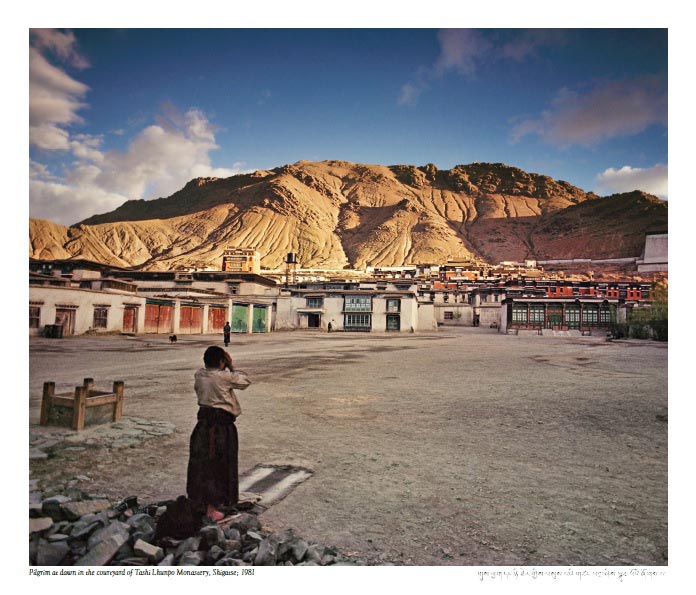
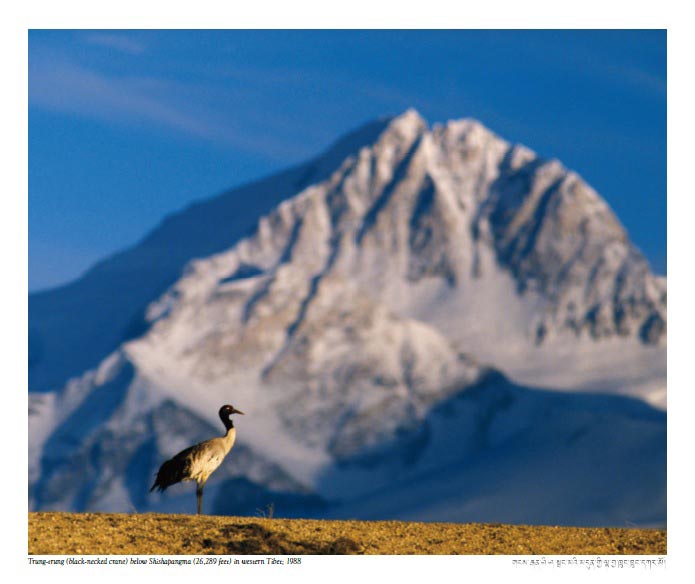
We are pleased this year to present to you a Special Edition 2016 ICT wall calendar titled “My Tibet” in honor of His Holiness the Dalai Lama’s 80th birthday. The calendar is now available for purchase at the ICT online store.
All the photographs and text featured in the calendar are from a special book titled “My Tibet” by the late photographer and adventure mountaineer, Galen Rowell. Galen’s passion for Tibet grew after travelling on assignment to Tibet a number of times in the mid to late 1980’s. He believed that the future of Tibet’s environment and landscape, would be best guided by Tibetans themselves, whose Buddhist culture teaches a reverence for the interdependence of humans and nature. He writes in the book,
“The Tibetan Plateau if one of those remaining legendary wild places, such as the Serengeti Plain, the Galapagos Islands, and Yosemite Valley, that must be preserved for their own sake for everyone instead of being altered for the short-term benefit of a few. So, too, should Tibetan culture be allowed to endure in its natural environment.”
Galen felt it very important to share the story of Tibet with a wider audience. This pursuit led him to the idea of a book of his photographs of Tibet, paired with quotes and responses of His Holiness to the images of a homeland that he had not seen with his own eyes for over three decades. So, Galen headed to Dharamsala, India, for his first audience with His Holiness the Dalai Lama.
In the introduction of the book, Galen describes His Holiness’s reaction to the first slide,
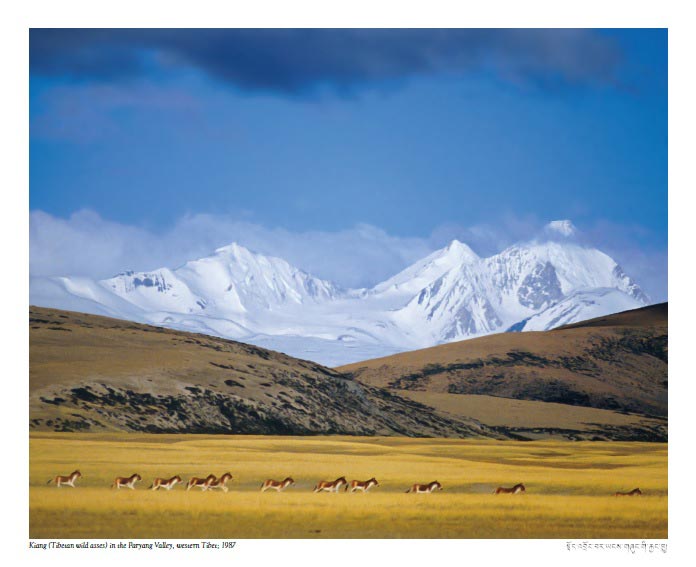
“The instant the animals appeared on the screen, His Holiness leapt of his chair in boyish delight … With an expression of sheer joy, His Holiness began pouring out his feelings: “We have always considered our wild animals a symbol of freedom. Nothing holds them back. They run free. So, you see, without them, something is missing from even the most beautiful landscape. The land becomes empty, and only with the presence of wild living things can it gain full beauty. Nature and wild animals are complementary. People who live among wildlife without harming it are in harmony with the environment. Some of that harmony remains in Tibet, and because we had this in the past, we have some genuine hope for the future. If we make an attempt, we will have all this again.”
(The first slide was a photo of a herd of kiang, the Tibetan wild ass.)
At ICT’s headquarters in Washington DC, we are lucky that many of Galen’s photographs and text hang on the walls around the office. Often times, I pause between steps to read a quote or gaze at a photograph. I find them poignant and deeply moving. These images of Tibet are from the mid to late 80’s, right around the time that ICT was established and when Galen was Co-Chair of the ICT’s Advisory Board. Even while more than 25 years have passed since these images were taken, and there have been further drastic changes in Tibet, these photographs are a stark reminder that Tibet today deeply needs the attention and support of the rest of the world.
It is also timely that just last month, the Central Tibetan Adminstration in Dharamsala, has launched a campaign urging “world leaders gathering in Paris for the UN COP21 climate change summit to recognize Tibet’s importance to the environmental health and sustainability of the planet, and as an environmentally strategic area, make Tibet central to global climate change discussions.” In a video message prepared for the climate change summit, His Holiness the Dalai Lama urges us all to protect the environment. He says the goal is to have “a healthy world, a healthy planet.”
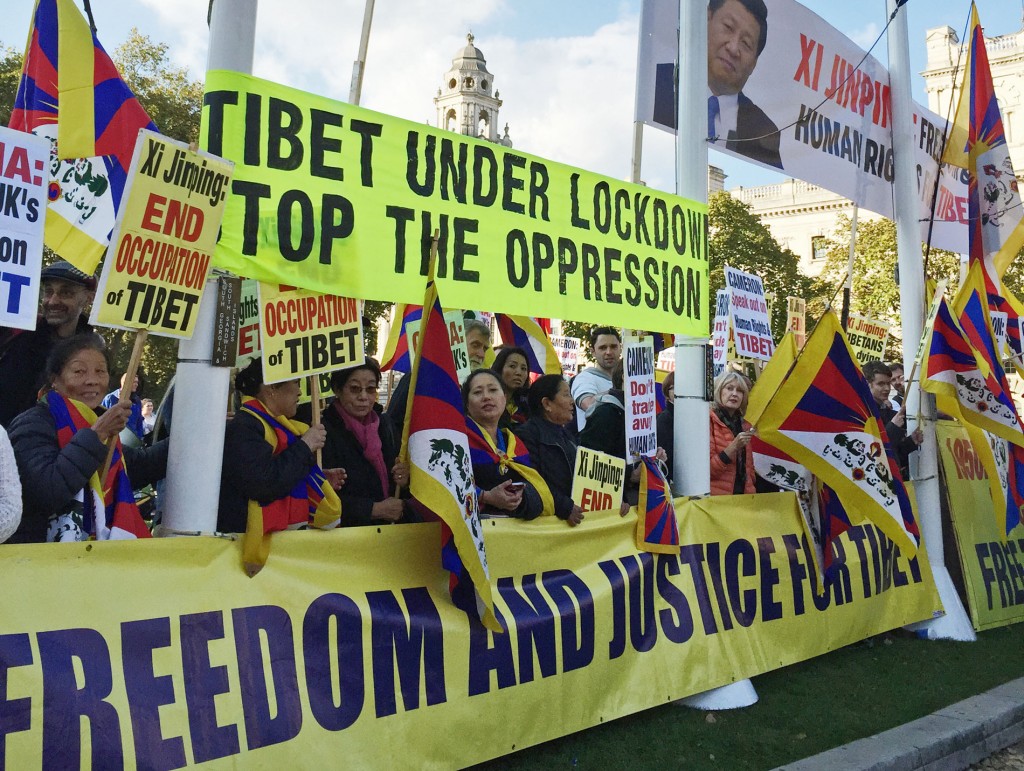
The day before UK PM Cameron entertained Xi Jinping for a pint in his local pub last week, a Chinese Tiananmen survivor and two young Tibetan women were locked up overnight by police in London and informed they were not allowed to be ‘within 100 metres’ of the ‘victim’ of their ‘harassment’, Chinese Communist Party boss Xi.
It was a troubling conclusion to a week in which the UK government faced an angry public backlash to ‘the great British kowtow’, in which the authoritarian leader of the Chinese Communist Party, currently presiding over the most serious crackdown in the PRC in a generation, was accorded a glittering surfeit of Royal pomp and obsequiousness in line with Chancellor Osborne’s new China policy of doing whatever the Beijing leadership wants.
As the golden carriage bearing Xi Jinping and the Queen progressed down a Mall lined with cheering Chinese students with immense red flags, uniform tee-shirts, drummers and dragons, dissident writer Ma Jian had tears in his eyes. “The message from the Chinese tyrants to their subjects is clear: if the queen of the UK, the oldest democracy in the world, lavishes your president with such respect and approbation, then what right have you to criticise him?” Ma Jian wrote.
Sonam and Jamphel, the two Tibetan protesters arrested during Xi Jinping’s London visit, welcomed by members of the Tibetan community in London on their release.
There were numerous attempts by the Chinese students and security personnel to obscure or intimidate the small number of Tibetans, Chinese (Falun Gong and others), Uyghur and other protesters on the Mall. Carole Beavis wrote that she was “singled out by three official looking Chinese men, who effectively herded me away from the event, lowered my arm holding the camera.”
Xi Jinping’s visit to the UK coincides with a terrifying crackdown on civil society in China in which lawyers and human rights defenders have been targeted, with many enduring horrific torture. More than 140 Tibetans have set themselves on fire, an act emerging from anguish at unbearable oppression, while moderate Uyghur academic Ilham Tohti is serving life in prison for peacefully advocating dialogue.
But it is not only within the PRC. Xi and the top Party leadership are aggressively seeking to export their assault on civil society and to roll back freedom and democracy in other parts of the world.
The three arrests in London last Wednesday are in the context of police being pressed elsewhere in Europe to take stronger measures against peaceful demonstrations (for example in Denmark and Belgium.
TV footage shows Shao Jiang, a British citizen who was imprisoned for 18 months after involvement with the Tiananmen Square protests, stepping into the road with two small white placards bearing the statements ‘end autocracy’ and ‘democracy now’. Several police officers charge towards him, knocking him off his feet, helmets flying, and take him into custody.
At the police station that night, the duty officer told me that they were accused of ‘conspiracy’ ‘to commit threatening behaviour’. But Shao Jiang had been on his own – could they mean that perhaps he had been thinking of standing in another part of the public highway with his two placards? Perhaps the two young women, Sonam and Jamphel, were conspiring to go and grab a cup of tea afterwards, as it was a grey and rainy day?
As they were being held in custody, police went to each of their homes and seized laptops, phones, and USB sticks. All three depend on their laptops for work; the computer of Johanna Zhang, Shao Jiang’s wife, who works as an artist and translator, was even taken. This was a chilling step, particularly given the obvious resonances; in Tibet and China, people understand the visceral fear associated with a knock on the door in the middle of the night.
Chinese Tiananmen survivor Shao Jiang is released on bail at Bishopsgate police station (charges are now dropped) by Tsering Passang, head of the Tibetan Community in Britain, and Kate Saunders.
In a debate in Parliament on Monday (October 26), Shao Jiang’s MP, Emily Thornberry, asked for the Home Office Minister to advise her “how I can hold to account those who made the disgraceful decisions to arrest someone who was, on the face of it, behaving in a way that was entirely peaceful, who should not have been arrested and whose house should not have been searched?” MP David Winnick, referred to “British police action with Chinese characteristics”. (Video available here.)
The arrests made front page news in the UK, in the context of an overwhelming public backlash against the UK government’s ‘epic kowtow’ to Communist Party boss Xi. Business leader and expert on China James McGregor, chairman of consultancy APCO Worldwide, told the BBC’s influential Today programme: “If you act like panting puppy the object of your attention is going to think they’ve got you on a leash. China does not respect people who suck up to them.” Mark Steel mused in The Independent: “If trade helps improve human rights, it’s about time we let North Korea and Isis run some of our industries.”
Steve Hilton, the UK PM’s former strategy advisor, tore into his friend Chancellor Osborne, arguing that kowtowing to China does nothing for Britain’s economic health: “Of course the Beijing oppressors would prefer not to be lectured in public on human rights. But if a convicted murderer said he’d prefer not to be lectured in public on the morality of killing people, would we say: ‘OK, we’ll keep your verdict secret’? […]
China is a superpower, aggressively spreading its influence. Our security and economic opportunity depend on an orderly world, underpinned by the values of openness. We need to stand up, strongly, for openness. If the world slides towards the opposite values, those of the Beijing dictators, we should be very nervous.”
In the meantime, The Times reported that senior military and intelligence figures have warned ministers that plans to give China a big stake in Britain’s nuclear power industry pose a threat to national security (see this great video).
In a bizarre media postscript to the visit, I was invited to join a Sunday morning TV show on which Ken Livingstone bucked the trend with the bizarre claim that the Dalai Lama had no credibility because he was a CIA stooge, while TV presenter Tricia Goddard did agree that the Duchess of Cambridge’s dress at the state banquet was a step too far.
Kate looked stunning as she clinked glasses with President Xi, but did she need to wear red, in homage to a man who is China’s most authoritarian and paranoid leader since Mao? A man who is so controlling that he even banned cartoons of Pooh Bear, after Chinese micro-bloggers picked up on an uncanny resemblance between a photograph of Xi and President Obama and a cartoon image of A. A. Milne’s cartoon creations.
On Wednesday night, two days after questions were raised in Parliament about their arrests, Scotland Yard said that the three protesters had been “released from their bail with no further action”. Their laptops and phones were returned today.
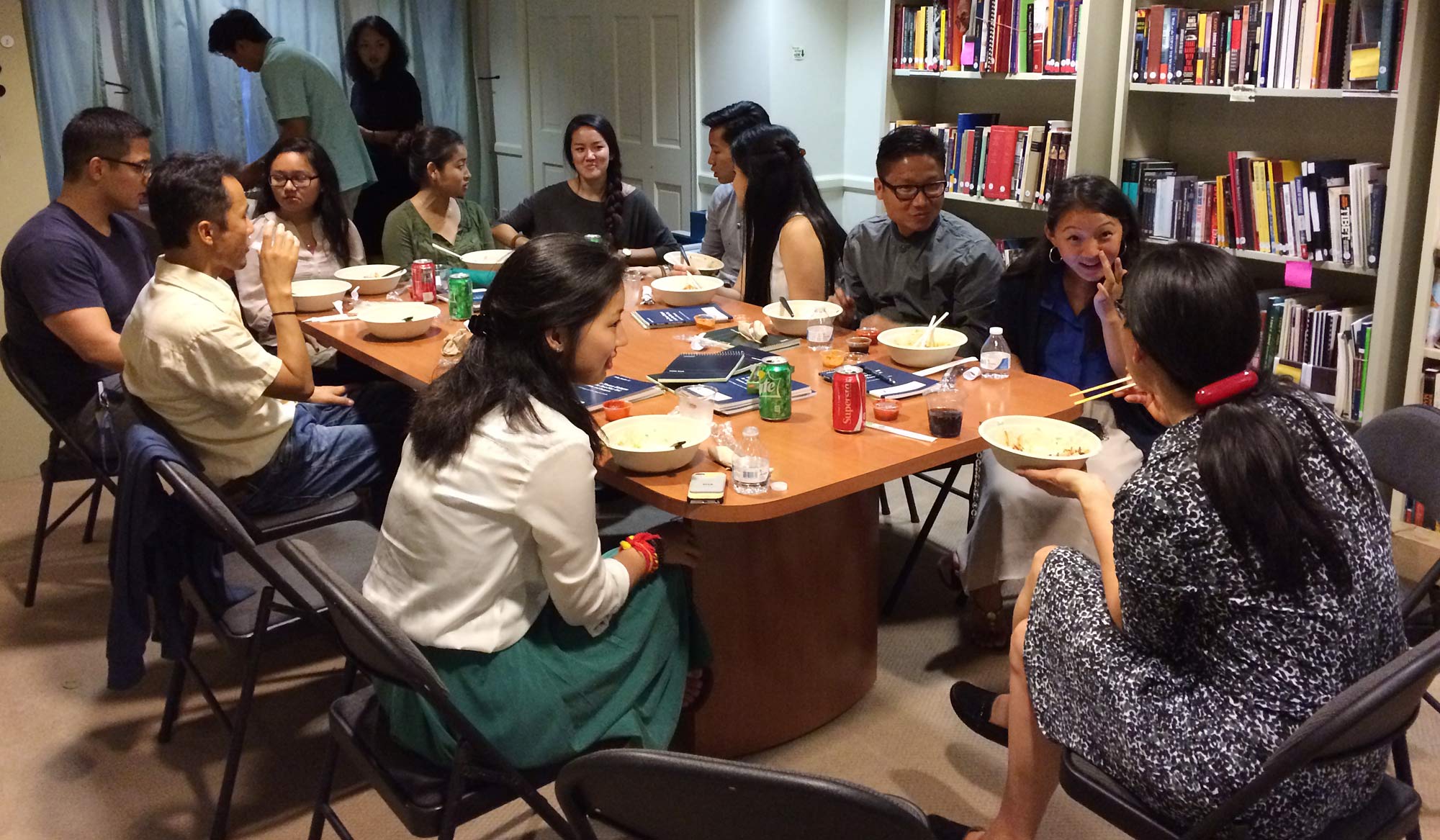
TYLP participant Pasang Tsering (in glasses) and others getting their orientation from coordinator Tencho Gyatso over dinner on the day of their arrival.
It was pouring heavily in New York City — June 1, 2015. My friend Tenzin who was also heading to Washington, DC, for the Tibetan Youth Leadership Program was anxiously waiting for me as the train departure was nearing. Bouncing along the streets in full swing, I eventually made it Penn Station right on time, but I was completely soaked, my glasses, backpack, suitcase and everything. No sooner, we settled down and the train started to move, and as I changed my shirt and jacket, I turned to my friend and told her with sigh, “Thank, God! We are escaping this nasty rain.”
To our utter dismay, the moment we reached Washington, DC, we were greeted with a thunderous shower as if it was following us all the way down from New York. That was hilarious! We Tibetans believe raining while embarking on a new journey is a sign of good luck and a probable success. Now when I look back, I think it might have been a really special symbol. Our seven days in Washington, DC, for Tibetan Youth Leadership Program organized by International Campaign for Tibet (ICT) was in deed special, very special.
Our agenda included visits to the National Endowment for Democracy (NED), Washington Media Institute, Radio Free Asia, Voice of America, Office of Tibet, Congressional Research Service, the House and Senate Offices, and the State Department. We also visited the White House, but that was just for an evening walk. In all seriousness, those aforementioned places where we visited really gave us rare insight and understanding of their significance in American political processes and the Tibetan issues.
Our resource persons for those meetings were NED President Carl Gershman, Chief of VOA Tibetan Service Losang Gyatso, Amos Gelb of the Washington Media Institute, Representative of H.H. the Dalai Lama and Central Tibetan Administration Kaydor Aukatsang, Congressman Jim McGovern and even the U.S. Undersecretary of the State and the Special Coordinator for Tibetan Issues Sarah Sewall.
Similarly, we sat down for series of panel discussions at the ICT office. Our guest speakers included a former Tibetan prime minister, Chinese human rights lawyer, a former Tibetan political prisoner, a motivational speaker, a former State Department senior official, and also ICT president, vice president and director of government relations.
Almost all our training sessions were less formal and more casual. Everyone participated in the discussion as necessary posing questions and adding comments. Just as much as we learned from our resource persons, we learned from each other too in so many ways. Our cohort of 13 attendees ranged from a rising junior to a doctorate candidate and we all had mostly different upbringing and educational and professional background.
For me, the leadership training was special not just because of the places we visited and the people we met and interacted with, but also because of the positive imprints that it instilled in each and every one of us in the process.
Of course, every attendee could have his or her own individual goal for going there, but Bhuchung Tsering, the vice president of ICT, set us a very clear collective goal on the very first day at the orientation. He said, “ICT has overarching goals to achieve from this training, but, in my view, if you can achieve one singular goal, it is more than enough and that goal is to change our mindset.”
Mr. Bhuchung Tsering highlighted the fact that we, Tibetans, identify ourselves as Tibetan refugees or simply Tibetans. Even younger generation who are born and brought up here on American soil consider themselves as Tibetan refugees or may be Tibetans, but not Americans. He stressed, “You are not only Tibetans, you are Tibetan-Americans, too. You are Americans just as everyone else in this country.”
The main reason why he was emphasizing us to recognize this fact was to encourage younger generation to engage ourselves into the civic and cultural life of the American society and be a part of the processes in making a difference here in the country and abroad. Simultaneously, we can help our ancestral land Tibet and Tibetan people through American political, economic and social processes.
This mission of changing our mindset might be a brilliant and doable idea for some, but a daunting challenge for others. We had attendees who were born and brought up here and they are through and through Americans just as they are through and through Tibetans. For them, they might be able to simply fine-tune their narrative. For those who recently immigrated to the United States, including myself, it was a lofty challenge. In fact, it is a constant struggle.
As someone who has a deep appreciation for Buddhist philosophy, I am always mindful of not being carried away by the three sources of evils — attachment, anger and ignorance. Hence, my challenge of finding difficulty in identifying myself as an American is not out of my attachment to my birthplace Nepal or my ancestral land Tibet or obsession with Tibetan pride for that matter, but it was rather my earnest effort in searching the American spirit within my soul deep down inside.
Never in my wildest dream would I dare to identify myself as an American simply because I want to claim rights or pursue personal ends. I would not do it even if the law of the land says I am an American citizen and that I am guaranteed with those inalienable rights for I believe every right comes with duties and one of those sacred duties is to be a genuine American by heart and mind, which can never be determined by one’s place of birth or a piece of paper nor by an accent of speech or color of skin.
To my great joy, another special moment of this training was I found a solace in my search of American spirit. Among many others, Tibetans and Americans have one but the most important thing in common i.e. our values. We are bound by our shared values that treasure life, liberty and pursuit of happiness. That to me is more than enough reason to tie the knot for these two partners once and for all — Tibetan-American!
Every time I watch the video of Tibetan nomad Runggye Adak going off-script while giving a speech at a major festival in Eastern Tibet, I’m struck by the disconnect between the simple action he took and the enormous consequences that followed. Adak, in full view of thousands of people, said what so many Tibetans think: “If we cannot invite the Dalai Lama home, we will not have freedom of religion and happiness in Tibet.” He went on to call for the 11th Panchen Lama and Tenzin Delek Rinpoche to be freed.
These are extremely common sentiments among Tibetans, but Adak paid a high price for voicing them out loud. After he walked away from the microphone he was seized by Chinese police, and within a month he had been charged with ‘provocation to subvert state power.’ During his trial he defended himself, saying: “I wanted to raise Tibetan concerns and grievances, as there is no outlet for us to do so.” Just the same, he was given 8 years in prison.
With that incident in mind, it was shocking and disappointing to see a co-owner of Politics & Prose bookstore in Washington DC help Chinese agents remove Lhadon Tethong from their store last week. Lhadon, the director of the Tibet Action Institute, had come to an event featuring Chinese State Council Information Office Deputy Director Guo Weimin with the intention of asking him about Tibet. As seen in the video below she started speaking several minutes into his remarks, which were delivered in promotion of Chinese Communist Party leader Xi Jinping’s book The Governance of China:
Xi Jinping's Book Launch – PART 1:Lhadon Tethong, Director of Tibet Action Institute, and Pema Yoko, Acting Executive…
Politics & Prose co-owner Bradley Graham, seen here pushing Lhadon out of the store, once wrote in the Washington Post that he’s concerned about the erosion of democratic discourse. Isn’t democratic discourse eroded when a store owner helps silence a Tibetan voice in favor of a state propaganda official from an authoritarian government? The Party has annihilated democratic discourse inside China. Last week they were able to export a small piece of their repression to a bookstore in America’s capital which bills itself as “a forum for discussion addressing the salient ideas of the day.”
While we’re on the subject, are there any salient ideas in Xi’s book? The Atlanticdescribes it as having “portcullises of dullness” which seem to “forbid readers from entering any further.” The “droning cadences” of Communist Party propaganda feature “familiar abstractions, the insistent buzzwords, and the numbing repetitions.” Xi’s description of the Chinese dream contains “unsettling echoes of 20th-century ethnic nationalism,” a paradise “primarily built for people of a single race.” The Chinese race, naturally- and to be clear, the idea that Tibetans and Uyghurs and Chinese are somehow all Chinese is a rhetorical fig leaf over the racial reality of the People’s Republic of China.
Tibetans inside Tibet run incredible risks whenever they speak their minds. It’s deplorable to see them silenced when they find opportunities to demand answers from Chinese officials outside China- especially when the author of the book is the leader of a police state sustained by the denial of free expression.
This article written by ICT President Matteo Mecacci, co-authored by ICT Vice President Bhuchung K. Tsering, was published on September 22 by The Huffington Post.
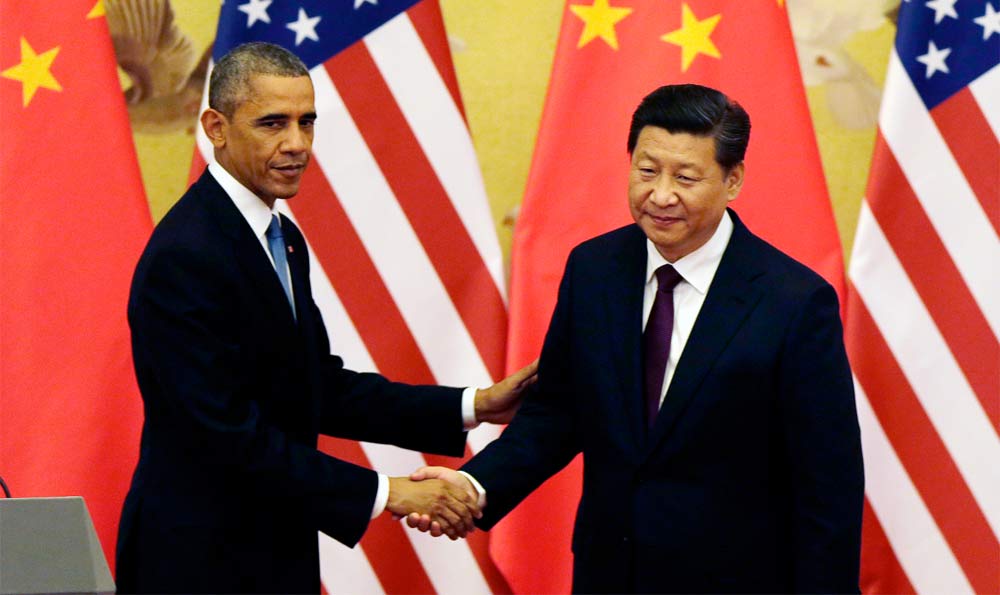
U.S. President Barack Obama, left, shakes hand with Chinese President Xi Jinping after their press conference at the Great Hall of the People in Beijing, China in 2014. (Photo: AP)
On September 24 later this month, China’s President Xi Jinping will arrive in Washington to meet President Obama for an important state visit. The context is a growing alarm about China’s less than peaceful rise, and provides a rare opportunity for the president to give an important message on Tibet.
It has been noted in Washington that President Xi’s self-proclaimed “China Dream” — a vision of a peaceful and rising China on the world stage — has become a Kafka-esque nightmare for many.
China’s government has been publicly blamed for major cyber attacks suffered by US federal institutions and businesses over the last months and more sanctions seem to be in preparation to target some of its officials. US and EU business leaders are now openly expressing concern for the safety of their work in China; fears that were previously reserved for political dissidents, Tibetan religious leaders, lawyers and journalists targeted by Beijing. CEOs and others are obviously concerned about the purge and targeting of city workers in China after the recent downturn of the financial markets.
There has been an unprecedented attack on Chinese civil society, resulting in the arrests of civil rights lawyers and peaceful activists. In Tibet, writers and artists have been tortured and imprisoned for singing about the Dalai Lama or expressing their views in literary journals.
The expansion of outposts in the South China Sea has unnerved China’s neighbors and US allies in the region and revived the debate about increasing US military spending to push back against what are perceived as Beijing expansionist aspirations in the Pacific.
The domestic anti-corruption campaign — with its international ramifications to recover financial assets — has not been followed up by a reform of the judicial system that provides independence. It is now perceived more as a way to eliminate other competing factions than a genuine attempt to implement the rule of law in the public sector.
We know that Tibet, as a strategic border area, is an important matter to China. The Party State has stepped up its rhetoric against the Tibetan leader, the Dalai Lama, in this context — which sits uncomfortably with the White House. President Obama has met the Dalai Lama four times and the two men enjoy a warm relationship.
The Dalai Lama’s peaceful advocacy and will to find a negotiated solution with China is highly respected in Washington, and his stature in the world stage as spiritual and moral leader increases with his age.
In the interest of China, and his own, Xi Jinping, certainly needs to give different signals to a world that is skeptical about his administration. A commitment to reduce carbon emissions in view of the COP21 UN Summit in Paris on climate change later this year is in the making, and would be certainly welcomed by the Obama administration, but it won’t be a surprise, as it won’t be enough expressing a general commitment to find “peaceful” solutions to the South China issues or to “fight against cyberterrorism.”
China can show to the world that it is really changing only if it can make profound reforms, such as moving from a centralized and authoritarian political system — which leads to its embrace of nationalistic and aggressive policies — to a more democratic and decentralized one, where the rule of law and a process of genuine consultations lead to sound political decisions.
For this, the Tibetan issue represents an important opportunity for Xi Jinping. By embracing the Dalai Lama’s sincere offer for dialogue based on his Middle Way Approach, and his decision to devolve his political authority to Tibetan institutions in exile — clearly indicating that he has no interest in going back to Tibet to rule — Xi Jinping would show that he is open to find some solutions to difficult and longstanding political issues that are of concern for the international community.
President Obama, who is also a Nobel Peace Laureate, should personally tell President Xi that he has nothing to fear from the Dalai Lama. The resistance by Tibetans to the decades-long policies of cultural and ethnic assimilation has been remarkably nonviolent so far, and this is largely due to the leadership provided by the Dalai Lama. It is the 80th birthday year of the Dalai Lama and this should provide a sense of urgency for resolving the issue in his lifetime. It is absurd to believe that Xi Jinping, leader of an atheist Party state, can ensure stability in Tibet through stage-managing a reincarnation of the Nobel Peace Laureate and seeking to eviscerate a peaceful religious culture.
Rather, by embracing the Dalai Lama President Xi might be able to bring about a change in the mindset of the international community on China and its future. China and its leaders know that despite its economic influence (which seem to be shaking currently) there is much distrust by the governments about China’s intentions and ambitions. If China respects the aspirations of the Tibetans for self-rule, the Dalai Lama could be a catalyst for China’s acceptance as a responsible member of the community of nations.
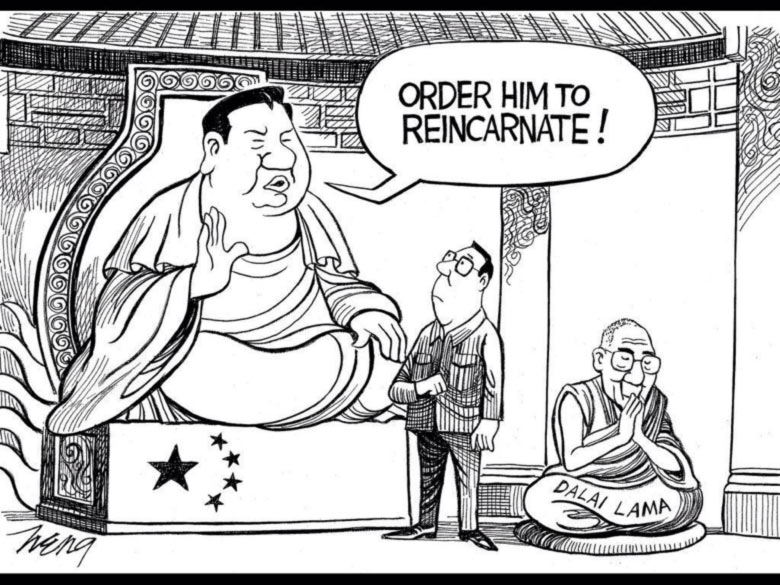
Communist Party officials visiting Beijing for annual meetings shook up the internet and saddled themselves with reams of bad press last week when they harshly attacked the Dalai Lama. That in itself isn’t anything new; even headline-grabbing accusations like claims that the Dalai Lama ‘betrays his country and his religion’ are just new iterations of Beijing’s old themes. What really got people’s attention is the way Party officials claimed ownership and mastery over the Tibetan Buddhist concept of reincarnate lamas: “Decision-making power over the reincarnation of the Dalai Lama, and over the end or survival of this lineage, resides in the central government of China,” senior Party official Zhu Weiqun told reporters.
NYT editorial cartoon- Xi Jinping tries to issue spiritual orders to the Dalai Lama.
There’s an obvious absurdity to this claim; Tibet expert Robert Barnett mentioned seeing Zhu’s statement “through the prism of Monty Python.” It might be useful to look at some of the specifics regarding Beijing’s claim though, in order to fully appreciate the absurdity of these ideas.
To begin, the Party has been riled up by comments the Dalai Lama made over the last few years concerning his reincarnation. He has speculated that he may return outside the borders of the People’s Republic of China, or as a girl, or that he may not be reborn at all. He has emphatically repeated that senior Tibetan Buddhist leaders, and the Tibetan people at large, will end up making the final decisions, and in the meantime as long as he remains in good health these matters won’t have to be decided for some time. Hence this reply, delivered by Padma Choling, the Chinese-appointed governor of the Tibet Autonomous Region: “Whether he wants to cease reincarnation or not, this decision is not up to him.”
Here the obvious absurdity reveals itself: if we take the Dalai Lama to be a human manifestation of Chenrezig, the Bodhisattva of Compassion, then we can safely say that the decision certainly does lie with him, and not with some department of the Communist Party of China. Padma Choling also asked reporters “if the central government had not approved it, how could he have become the 14th Dalai Lama? He couldn’t.” And yet, he did- because the central government he’s referring to now, established by the Communist Party, didn’t yet exist when the current Dalai Lama was recognized. The central government of China at the time was that of the Republic of China, which has since relocated to Taiwan. It’s worth noting that their involvement was minimal, as well- their representatives arrived after traditional Tibetan methods had been used to confirm the identity of the child, and they merely joined other foreign delegations in attending the enthronement ceremony. The Party would like you to believe that they presided over the ceremony, but historian Tsering Shakya has found no evidence supporting this claim.
Recently the Party has begun insisting that the use of a Qing dynasty relic called the Golden Urn is crucial for recognizing reincarnate lamas. My colleague Pema Wangyal examined the history of the Golden Urn last year, and his findings significantly undermine the Party’s position. The Golden Urn was only involved in the selection of three out of the fourteen Dalai Lamas, and just two of the first ten Panchen Lamas. Notably, the current Dalai Lama was selected without the use of the Golden Urn.
The Communist Party obsession with the Golden Urn has a much deeper flaw, though. As Elliot Sperling points out, the only reason the Golden Urn had any legitimacy in the past is that the emperors of the Qing dynasty practiced Tibetan Buddhism. Emperor Qianlong was acknowledged as an emanation of Manjusri, and he was considered by some to have powers of discernment that might help in the process of searching for reincarnations. Today’s Communist Party leaders have no such faith, and no such acknowledged spiritual roles. The rules of the Communist Party would even appear to make this impossible, as atheism is a must for senior Party leaders.
Even then, the patron-priest relationship that linked the Dalai Lamas to China in the past was formally abrogated by the 13th Dalai Lama in 1913. In the absence of any such arrangement, Beijing would be wise to leave spiritual matters like the recognition of reincarnate lamas to qualified spiritual authorities. This will spare them from the absurdity of documents like State Religious Affairs Bureau Order No. 5, a 2007 Chinese law which says people who plan to be reborn must complete an application and submit it to several government agencies for approval. It’s a law which somehow manages to make a mockery of both the Communist Party’s supposed atheism and the religious institutions of Tibetan Buddhism.
To borrow their words, Zhu Weiqun and Padma Choling have taken an ‘extremely frivolous and disrespectful attitude’ towards this issue, and a good first step towards sorting it all out would be for them to stop intentionally conflating the relationships Tibet and Tibetan Buddhism has had with the Communist Party, the Republic of China, and the Qing dynasty. Tibetan Buddhist leaders like the Dalai Lama are perfectly capable of making their own decisions regarding the future of Tibetan Buddhist institutions, and they should be free to do so without outside interference.
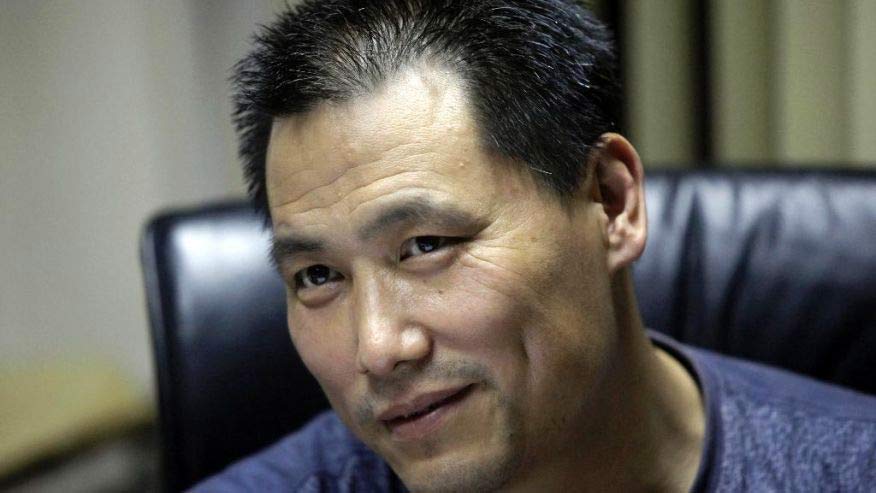
Imagine a country which is openly denying ethnic minorities the right to check into hotels, and to receive passports. Imagine a country where a rights lawyer from the majority ethnicity calls these kinds of policies ‘ridiculous.’ And finally, imagine a country where the criminal charge of ‘inciting ethnic hatred’ that soon follows is brought against the lawyer for opposing these policies, and not against the government agencies responsible for instituting them.
The lawyer is Pu Zhiqiang, a smart and steadfast man whose commitment to defending rights runs all the way back to his participation in the 1989 Tiananmen Square movement. He has defended high-profile Tibetans, including Karma Samdrup, and Perry Link described his outlook on minorities in the PRC thusly:
In his comments on Uighurs and Tibetans, Pu tries to appreciate how ethnic minorities see things—not ideologically but as practical matters of daily life. He hears about a new regulation ordering that Buddhist temples in Tibet hang portraits of the top Chinese leaders—all Han—and that the stated reason for the move is “to dissipate religious consciousness.” He posts: “Are Han heads insane? Or only the head Hans?”
Pu Zhiqiang
The latest word is that Pu rejected the charges as groundless from his cell in a detention center, but it seems unlikely a Party-picked judge will agree- as Andrew Jacobs of the New York Times reminds us, as of 2013 Chinese courts had an acquittal rate of just 0.007%. Jacobs referred to legal experts who say that the issue centers on “China’s party-run judiciary, a system in which the police, prosecutors and judges work together to ensure convictions.” The consequences could be severe for Pu, who would face an 8-year prison term. The evidence presented by the government as proof of his incitement of ethnic hatred comes in the form of a handful of Weibo posts, the equivalent of tweets.
Meanwhile, Tibetans find it difficult to leave the country, and difficult to stay in it as well. Freedom of movement is one of the most basic and fundamental human rights, something enshrined in both the Universal Declaration of Human Rights (to which China is a signatory) and in the first Constitution of the People’s Republic of China (although it was later removed after the institution of the hukou system). The restrictions on passports, which are implemented in some places by requiring Tibetans to hand in old passports and then denying them new ones en masse, are completely unlike the way the Communist Party treats Chinese people. Domestic travel has become just as difficult, with Tibetans who live outside the Tibet Autonomous Region [TAR] finding it difficult or impossible to visit the TAR, and with Tibetans inside the TAR encountering new restrictions on their movement within their own ‘autonomous’ region. “We can’t accept Tibetans,” one hostel worker told Radio Free Asia. “It’s clearly stated in the police regulations.”
By choosing to charge Pu while they continue the practice of structural discrimination, the Party makes it clear that in their view ‘ethnic hatred’ isn’t incited by those who violate the rights of China’s ethnic minorities, but rather by those who call for these violations to end. It’s a view that reflects the absolutely dominant position that the Chinese hold in the Communist Party, and one that leaves no place for the view of the minorities- a polar opposite to the way Pu viewed the Tibetans and Uyghurs.
Didi Kirsten Tatlow recently wrote from a Chinese elementary school where students are taught mnemonic devices involving bloodthirsty Japanese people, and where parents muse about how “Tibetans are considered inferior and such allegedly inferior people will never lead China.” In Xi Jinping’s China they’re far less likely to get in trouble for ‘inciting ethnic hatred’ for saying something like that than someone else would be for commenting on it.
ICT has translated into English the first major speech in Beijing by Gyaltsen Norbu, known as the ‘Chinese Panchen (Gya Panchen)’ because he was selected by the CCP after the boy recognized by the Dalai Lama and acknowledged by Tibetans as the authentic incarnation, Gendun Choekyi Nyima, was ‘disappeared’ in 1995. There is no indication of his whereabouts or welfare 20 years later.[1]
Gyaltsen (Gyalcain) Norbu, 25, was installed by the Chinese authorities as part of their efforts to ensure control of Tibet and assert their authority over a future incarnation of the Dalai Lama,[2] and is compelled to conform to the role of ‘official’ Panchen Lama as a ‘patriotic’ figurehead with allegiance to the CCP. This perhaps makes one of his statements in the March 2 speech, before top Chinese leaders at a Party meeting,[3] all the more telling. Because of the shortage of monks in Tibet and “quotas set too low”, he says, there is “a danger of Buddhism existing in name only”.
Gyaltsen Norbu made the usual provisos in line with Party policy, asserting that Tibetan Buddhism is thriving in Tibet, just as the 10th Panchen Lama carefully framed his arguments.[4] But his main contention counters existing policy – for instance, officials do not even admit to monastic ‘quotas’.
The context of the March 2 speech, which has appeared so far only in Chinese in the state media, is an intense debate on the future of Buddhism in Tibet and China. More Chinese people are becoming devout followers of Tibetan lamas,[5] and Xi Jinping talks about the importance of China’s ‘traditional cultures or faiths’ including Buddhism. The Chinese Communist Party wants to give an impression that Buddhist faith is flourishing in Tibet and is acutely aware that the leaders of its main schools all reside in exile, with the Dalai Lama a globally respected figure. So they may be seeking to use Gyaltsen (Chinese: Gyalcain) Norbu in a more sophisticated way than before, and his comments may reflect an approach that some officials want to convey. Even so, Gyaltsen Norbu’s speech was reminiscent of the skillful phrasing used by the 10th Panchen Lama in parts, and he has made lengthy visits to a number of Tibetan monasteries, with senior lamas and scholars as his teachers. Their concerns appear to be reflected in his comments.
Gyaltsen Norbu’s speech is framed carefully in accordance with the Party line on religion, stating that in the “glow of the Party’s ethnic and religious policies”, Tibetans, Uyghurs and other ethnicities enjoy “freedom of religious belief” and normal religious practice and preservation of culture. But his main contention differs from policies that threaten the survival of Tibetan Buddhism in Tibet today, as he pinpoints the shortage of monks in Tibet and “quotas set too low” as serious problems.
The Chinese authorities do not openly admit that ‘quotas’ on monks and nuns in monasteries and nunneries exist. The government line is that the correct number of monks varies according to the monastery’s capacity to support them; Buddhist associations and monastic management committees are the proxies for the government in approving or reviewing such matters. In effect, this represents a government-approved ‘quota’.[6]
On February 12, Gyaltsen Norbu was pictured by the state media with Sun Chunlun, the head of the United Front Work Department who is also on the top Politburo.[7] It is unlikely that Gyaltsen Norbu would make the March 4 speech before members of China’s top leadership[8] without any official approval beforehand, although this may not have been from the United Front Work Department, which seeks to uphold a strong line on religious policies in Tibet and hostile approach towards the Dalai Lama. By directly addressing his remarks to Yu Zhengsheng, one of China’s top leaders who heads an important Party committee on ethnic and religious affairs, Gyaltsen Norbu effectively cut out any attempts by Tibetan or other less senior officials to filter his comments. Such officials, including from the United Front, normally serve as a buffer telling the central government that central religious policies are a success and there is no need for concern.
The context of the Chinese Panchen Lama’s comments is a deteriorating environment for Tibetan Buddhism which worsened significantly after overwhelmingly peaceful protests swept across Tibet in March and April 2008. The Chinese Communist Party state responded to the protests by intensifying an established anti-Dalai Lama campaign, issuing sweeping regulatory measures that intrude upon Tibetan Buddhist monastic affairs and implementing aggressive “legal education” programs that pressure monks and nuns to study and accept expanded government control over their religion, monasteries, and nunneries.
A further factor contributing to the shortage of monks – and one that is not mentioned in Gyaltsen Norbu’s speech, although it is perhaps implied – is the expulsion of monks and nuns from many monasteries, particularly in the Tibet Autonomous Region. Since a wave of overwhelmingly protests spread across Tibet in March, 2008, monasteries of historic and cultural significance have been targeted by the authorities. After monks from the ‘Great Three’ monasteries in Lhasa of Sera, Drepung and Ganden took to the streets in March, 2008, the monastic population has been subject to intensified suppression and the strengthening of control mechanisms.[9] Hundreds of monks have been expelled and arrested from these three monasteries, leading to serious fears for their survival as religious institutions.[10]
Gyaltsen Norbu’s comments appear to reflect a genuine alarm that monasteries in the Tibet Autonomous Region that once housed thousands of monks are now reduced to a few hundred whose main responsibility is no longer religious study but tending to the buildings and tourists. Many of the monks in these major monasteries were from Amdo, Kham, Mongolia, and the broader Himalayan region, and Gyaltsen Norbu does not mention in his speech the policies restricting them from studying in the Tibet Autonomous Region. The number of monks studying at large religious encampments in Tibetan areas of Kham, such as Larung Gar (Serthar) serves as a visible reminder of the potential that monasteries in the Tibet Autonomous Region are not allowed to fulfill.
After the 2008 protests, Tibetan language, culture and monasteries have been depicted by many Party officials as a source of instability. In his speech, Gyaltsen Norbu re-frames the issue by depicting them instead as a source of “stability”, saying: “Tibetan Buddhism is capable of playing a huge role in national economic and social development, and social harmony and stability.” In this way he opens a discussion of Buddhism and Buddhist ceremonies and rituals as something that people in the Tibet Autonomous Region require, and the lack of ability to provide these services as a shortcoming.
Gyaltsen Norbu gives a higher number of monks and nuns in Tibetan areas than usually acknowledged in official statistics, indicating that even this higher figure is not enough. He refers to 1,787 religious venues with 46,000 resident monks and nuns in the Tibet Autonomous Region, plus 783 monasteries and 68,000 monks and nuns in Sichuan, and 660 monasteries and 44,500 monks and nuns in Qinghai. This is a total of 158,500 without including the Tibetan areas of Gansu and Yunnan. The figure of 46,000 resident monks in the Tibet Autonomous Region has been standard in official representations since the 1990s.[11] More recently United Front Work Department official Zhu Weiqun gave the figure of 140,000 monks and nuns in the Tibet Autonomous Region and other Tibetan areas.[12]
While not recognized as the legitimate Panchen Lama by Tibetans, Gyaltsen Norbu has made lengthy visits to a number of Tibetan monasteries and had access to senior Buddhist teachers and scholars. Their concerns may be reflected in his comments; he makes specific reference to particular areas, for instance to the western area of the Tibet Autonomous Region where the sacred Mount Kailash is situated, saying: “I went to Ngari, and I learned: Ngari [Chinese: Ali, Tibet Autonomous Region] has 75 monasteries, and not one of them can hold a Buddhist meeting [in accordance with proper religious procedures and protocols.]”[13]
Few insights have been available into Gyaltsen Norbu’s views due to the stringent oversight of his activities and management of his public appearances by the Party authorities, who require him to convey the message that Tibetans have freedom to practice their religion. Although monks are often instructed to display his photographs, there is little evidence that many adhere to this request. After arriving in exile in India, a monk from Tashilhunpo monastery in Shigatse, the Panchen Lama’s seat, told ICT: “Since Gyaltsen Norbu was chosen as the Gya Panchen Lama, the majority of monks have lost their trust in the monastery, as well as lacking loyalty to the Chinese choice. When Gyaltsen Norbu visits [our monastery], you are not allowed to leave for two days before and after his visit, or it will be considered a political act. Usually young monks don’t display his photos in our rooms but elderly monks, for example my teacher, they always tell us to display it but they say, ‘Don’t worry. Just do whatever they say. If you don’t accept him from your heart then it doesn’t make any difference whether you display his photo or not.’”[14]
The Chinese Panchen Lama’s comments are made in the context of a complex, changing picture in Tibet. Beyond the stringent measures of state control, there are of course other social and economic factors involved in the decline in numbers of monks at many monastic institutions.[15]
In Tibet today, an oppressive crackdown co-exists with the resilient spirit of the Tibetan people in defending their religion and culture, and a growing Chinese interest in Tibetan Buddhism. Last month, remarkable footage from Kumbum monastery, one of the great Gelugpa institutions in Tibet, showed thousands of Tibetan pilgrims gathering at a prayer ceremony despite an intimidating paramilitary troop presence.[16]
At the same time, Tibet’s religious culture is inspiring millions inside the PRC; increasing numbers of Chinese people are becoming practitioners, with many making devout pilgrimages to Tibet, or following Tibetan lamas. Some popular lamas have tremendous influence and following among Chinese, and prominent indications of this trend include a front page story about a Tibetan lama in a Chinese magazine, People Weekly, telling the story of “how a young shepherd becomes a great Tibetan Buddhist teacher of millions of students, with over 1.5 million followers on Weibo”.[17] In January, a former Chinese Communist Party official Xiao Wunan invited the BBC into his home and showed them footage of his audience with the Dalai Lama.[18]
While these developments are of immense importance to Tibet’s future, and despite the evidence of some moderate and progressive views, a White Paper released by the Chinese state media on April 15 provided sobering confirmation of the current dominance of the anti-Dalai Lama, ‘anti-separatist’ power-bloc in the Beijing establishment.[19]
[2] Tibetans refer to Gyaltsen Norbu as ‘Gya Panchen’, meaning Chinese Panchen. Panchen Lamas have previously played a role in the recognition and subsequent education of Dalai Lamas, and vice versa, which is why control over the institution is considered to be so crucial by Beijing.
[4] The Tenth Panchen Lama died on January 28, 1989, after enduring 14 years in prison in the Mao era. He had submitted what is believed to be the most extensive internal criticism of Chinese Communist policies ever submitted to the leadership, documenting the mass arrests, executions and oppressions in Tibet that followed the 1959 Uprising. Mao Zedong famously denounced the report as “a poisoned arrow shot at the Party” and its author as a “reactionary feudal overlord”. It was published by Tibet Information Network in London (now closed) in 1997, in English translation.
[8] It was at the Third Session of the 12th Chinese People’s Political Consultative Conference (CPPCC) National Committee.
[9] Numerous reports detail the suffering of monks in custody. Tibetan writer Woeser wrote on her blog: “During the monks’ time in detention, a 22-year-old monk called Jigme Phuntsog who had fallen ill and been seriously misdiagnosed by the military hospital deteriorated suddenly after 20 days and died without being treated. Another monk of around 30 years old simply couldn’t bear it any longer. He started banging his head against the wall and then jumped from the window when he was taken to hospital. He broke several bones and is deaf in one ear.” See ICT report, ‘A Great Mountain Burned by Fire’, https://www.savetibet.nl/fileadmin/images/ictreports/A_Great_Mountain_Burned_by_Fire_ICTReport.pdf
[10] Monks in other areas of Tibet, who traditionally visited these monasteries for period of study, are no longer allowed to do so. The Chinese state media acknowledged that a total of 1200 monks from Drepung and Sera had been expelled in 2008. For full details, see ICT report, ‘A Great Mountain Burned by Fire’, https://www.savetibet.nl/fileadmin/images/ictreports/A_Great_Mountain_Burned_by_Fire_ICTReport.pdf. The Chinese authorities have also singled out other important and influential centres of Tibetan Buddhist culture outside the Tibet Autonomous Region – notably Kirti monastery in Ngaba (Chinese: Aba), Sichuan (the Tibetan area of Amdo), where the current wave of self-immolations in Tibet began in 2009. The situation at Kirti escalated in 2011 when monks from the age of 18-40 were taken away from the monastery under the pretext of giving them “legal education”. Local laypeople who tried to prevent them being removed were violently beaten by troops surrounding the monastery. As with Sera, Ganden and Drepung in Lhasa, the authorities used the pretext of taking monks away “for study” or “legal education” as a means to reduce and control the monastic population at Kirti. A full account of these developments is given in International Campaign for Tibet’s report, “Storm in the Grasslands: Self-Immolations in Tibet and Chinese Policy”, December 2012, http://www.savetibet.org/resource-center/ictpublications/reports/storm-grasslands-self-immolations-tibet-and-chinese-policy.
[11] The figure of 1,787 religious ‘venues’ in the Tibet Autonomous Region has also been given in previous official statistics, such as an article in China Daily on December 24, 2012. The same article referred to progress made in the ‘patriotic education’ campaign in the Tibet Autonomous Region, reporting that: “In 2014, more than 50,000 copies of [patriotic education] documents were distributed [….] to Buddhist monasteries across the Tibet Autonomous Region and more than 100,000 Tibetan Buddhist monks and nuns participated the sessions.” The article noted that one of the main subjects of the campaign was for monks and nuns to declare their dissociation with the “Dalai clique”.
[12] His comment in 2012 was as follows: “There are 3,542 monasteries and 140,000 monks and nuns in Tibet and other Tibetan-populated regions.” (Xinhua, 7 March, 2012).
[13] In his speech, Gyaltsen Norbu says that Buddhism has specified that where four or more monks have formed a group, they should regularly hold Buddhist meetings in order to discuss and inspect their adherence to the precepts.
[14] The same monk said that even so, ordinary Tibetans recognize the pressures that Gyaltsen Norbu is under given his unique role: “I have heard that Gyaltsen Norbu is smart and recognizes his Tibetan identity and responsibility.” ‘An Insight into the Gya Panchen’, p 53-55, ‘The Communist Party as Living Buddha: The Crisis facing Tibetan Religion under Chinese control’, ICT report, http://www.savetibet.org/the-communist-party-as-living-buddha/
[15] For instance, see papers by Dr Jane Caple from Manchester University, who writes: “Monastic actors are facing serious challenges as they attempt to ‘move with the times’ while maintaining the soteriological and mundane bases of monastic Buddhism in rapidly changing political, economic and social contexts. Thus far, accounts of the revival have largely been framed in relation to the Chinese state, the shifting public space for religion and culture and the ‘Tibet question’. This study attempts to ‘see beyond the state’ to examine other contingent factors in the ongoing process of renewal and development.” (‘Seeing beyond the state: The negotiation of moral boundaries in the revival and development of Tibetan Buddhist monasticism in contemporary China’, Jane Caple, 2011, https://www.escholar.manchester.ac.uk/uk-ac-man-scw:199630.)